
Ask a room of players to describe a Milan violin and the same words come back: warm, sweet, big. That reputation is not marketing. It comes from a group of makers working in one city who shared models, working habits, and in many cases the same workbench.
If you are moving up from a commercial student instrument, or replacing a violin you have played for twenty years, knowing where that sound comes from tells you exactly what to listen for when the case opens.
| Era | Workshop / Maker | Known For |
|---|---|---|
| 1600s to 1700s | Grancino, Testore | Founded the older Milanese tradition; broad, singing tone that grew out of early Amati influence |
| Mid to late 1700s | Landolfi, Mantegazza | Carried the tradition forward; Mantegazza built a business restoring instruments for collector Count Cozio di Salabue |
| 1886 to 1945 | Leandro Bisiach workshop | Defined the modern Milan school; trained Riccardo and Romeo Antoniazzi, Gaetano Sgarabotto, Giuseppe Ornati, Ferdinando Garimberti, and Igino Sderci |
| Early 1900s | Celeste Farotti | Rival Milan workshop, working from Pressenda and Rocca models rather than strict Cremonese copies |
| 1978 to present | Civica Scuola di Liuteria di Milano and contemporary makers | Living continuation of the school, building on the same models and tonal goals today |
What Players Mean by the Milanese Tonal Identity
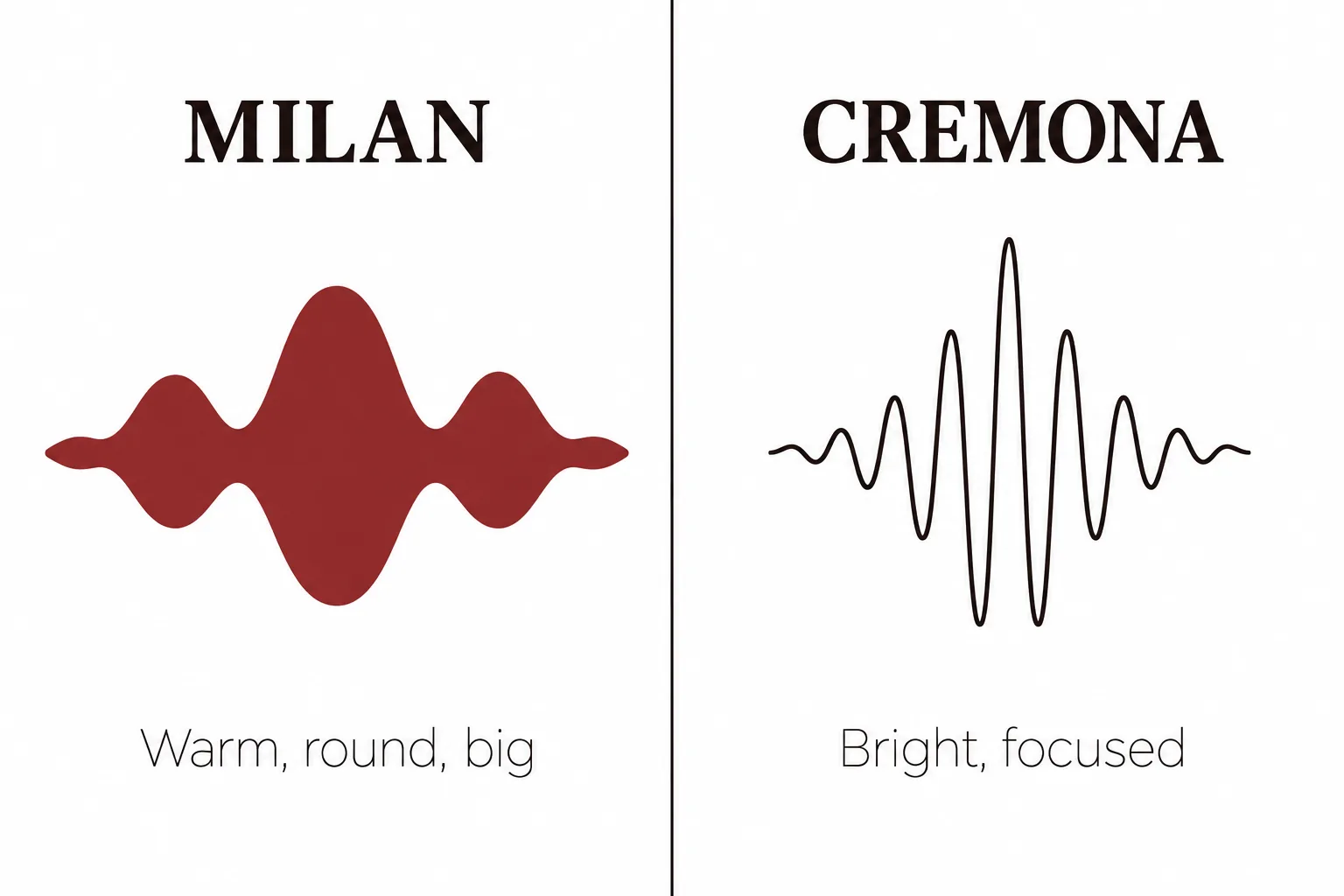
Tone talk gets vague fast, so here is the plain version. Instruments from the 20th-century Milan school tend to give a round, full low register, a sweet top end that does not turn glassy, and volume that travels out into a hall instead of staying under your ear. Players call them generous: the instrument gives back more than you put in.
Set that against the Cremonese ideal most of us carry in our heads, which leans brighter and more tightly focused, with a narrow, cutting E string. Neither is better. They suit different players and different jobs. A section violinist playing long rehearsals often wants the Milanese warmth. A soloist trying to carry over an orchestra may want the focus.
A school sounds like itself for unglamorous reasons. Makers working side by side copy the same outlines, shape the curve of the top to similar heights, buy wood from the same suppliers, and mix varnish the way the person who taught them did. Repeat that for a generation and you get a family resemblance you can hear.
Milan Before Bisiach: The Older Milanese Tradition
Milan was building fine instruments long before the 20th century. The Grancino and Testore workshops were at work in the city during the 1600s and 1700s, and their output was never a copy of what was happening in Cremona or Brescia.
Milanese makers worked under heavy early influence from the Amati and Cremonese tradition, but by the late 1600s had developed their own outlines and a broad, singing quality that set them apart from the tight brilliance associated with their neighbors.
That history matters for one reason: the modern Milan school did not appear out of nowhere. When instrument making revived in the city two generations later, it wasn’t picking up where Grancino and Testore left off.
It was closer to a fresh start that happened to land in the same place, on players who needed more sound in bigger halls.
The line didn’t end with Testore, either. Carlo Ferdinando Landolfi worked in Milan through the second half of the 1700s, and his work shows a clear change in direction, likely shaped by contact with Giovanni Battista Guadagnini during Guadagnini’s brief stay in the city.
After Landolfi, the Mantegazza family, led by Pietro Giovanni Mantegazza, carried the Milanese tradition through the final decades of the century and built a significant business restoring and “modernizing” older Cremonese instruments for the collector Count Cozio di Salabue.
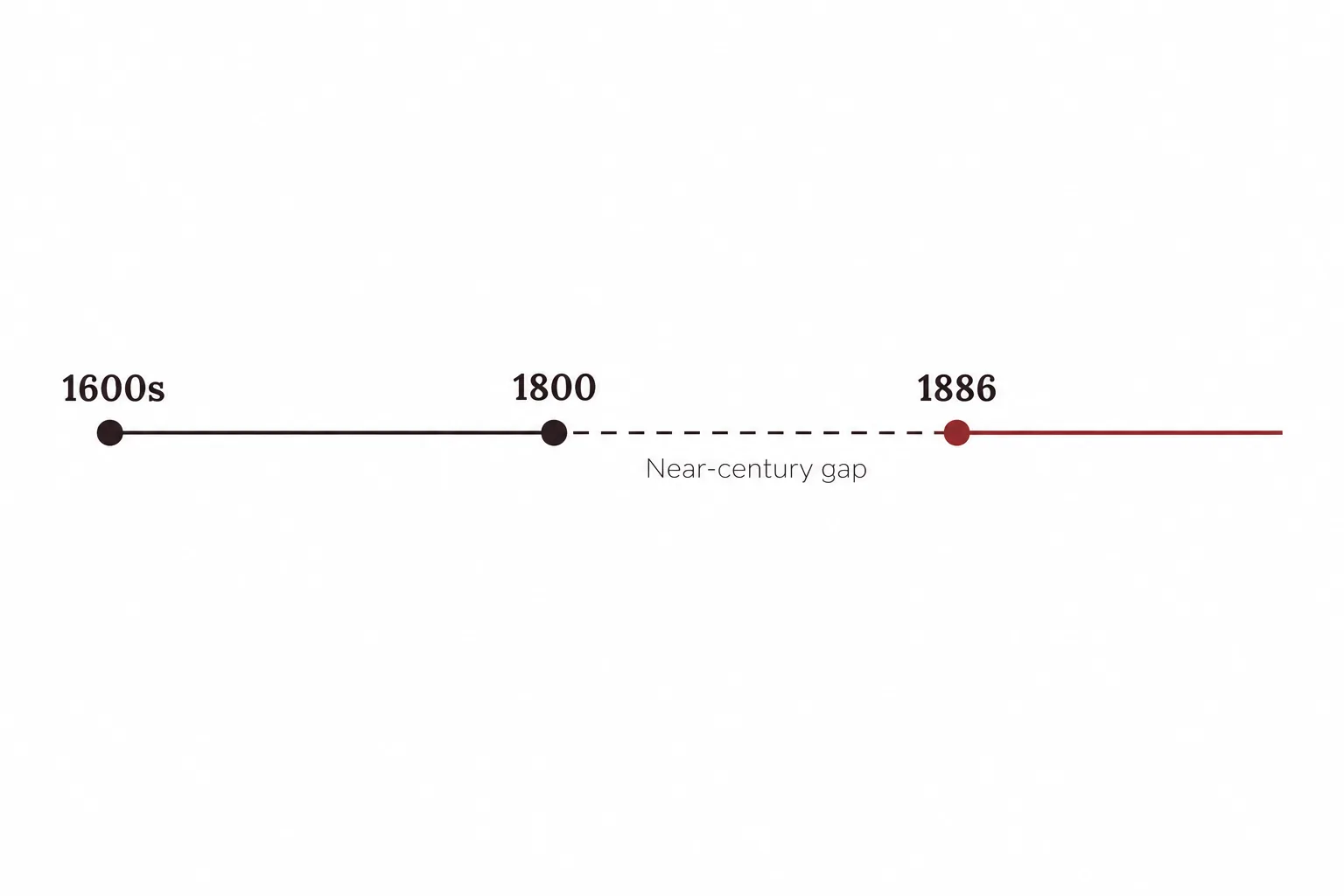
Then the thread breaks. Violin making in Milan didn’t disappear after 1800, but neither the Grancino-Testore line nor the Landolfi-Mantegazza line continued into the new century, and the city wouldn’t regain its standing for close to a hundred years. That gap is worth knowing, because it changes how the Bisiach story should be told.
Leandro Bisiach and the Rise of the Milan School
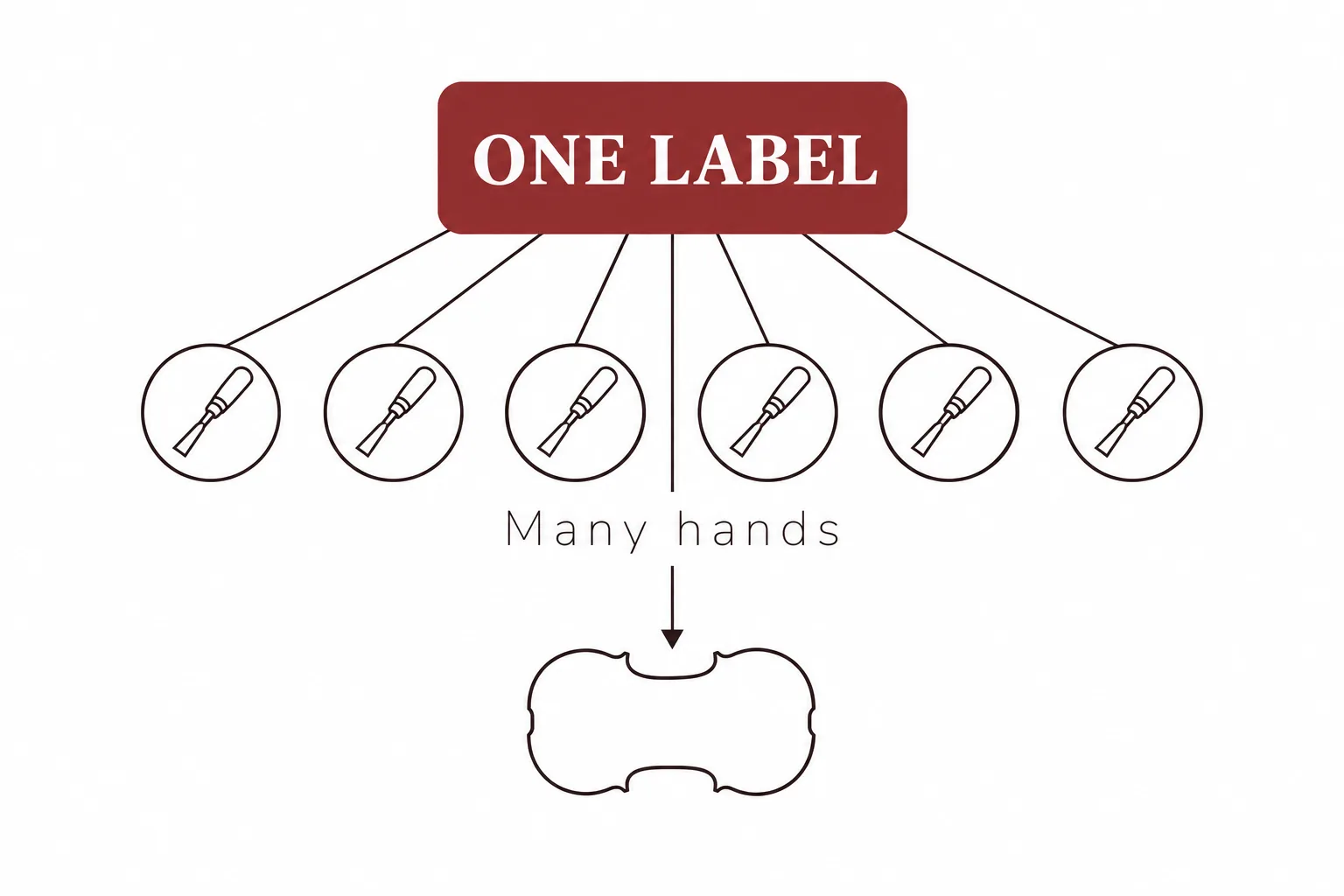
The workshop that pulled all of this into a recognizable school was Leandro Bisiach’s, and he is widely regarded as the dominant figure in modern Milanese making. His shop ran on a model common among successful houses of the period: a master directing a group of highly skilled makers, with the finished instruments going out under one label.
The makers documented as working at Bisiach’s bench include Riccardo and Romeo Antoniazzi, Gaetano Sgarabotto, Giuseppe Ornati, Ferdinando Garimberti, and Igino Sderci, names that carry real weight on their own today. The Bisiach name then continued through the family, including Giacomo, Leandro II, and Carlo.
For a buyer, that structure cuts both ways. It produced remarkable consistency: house model, house setup, house sound. It also means a Bisiach label tells you which shop an instrument came out of, not necessarily whose hands did the carving.
That is not a scandal; it is simply how the trade worked, and it is one of the first things we talk through with a player considering a violin by Leandro Bisiach rather than something we gloss over.
The Workshop as a Training Ground
Because so many gifted makers passed through, the Bisiach bench functioned as a school in the literal sense. That roster of trained hands went on to sign their own instruments, carrying the model preferences, the arching habits, and the varnish character with them. It is a large part of why so much fine 20th-century Italian work shares a family resemblance in both look and sound.
The practical takeaway is worth more than the history. If a Bisiach-labeled instrument sits above your budget, the same tonal character is often available in work by makers who trained or worked there, at a very different price. Shop by sound and by lineage rather than by label alone. Our inventory is organized so you can follow the Bisiach workshop lineage and hear the relationship for yourself.
The Milan School After Bisiach
Bisiach wasn’t working alone in Milan. Celeste Farotti, born the same year, just a few months younger, built a rival workshop a few streets away. Where Bisiach’s bench leaned toward strict Cremonese copies, Farotti’s own instruments took their cue from Giovanni Francesco Pressenda and Giuseppe Rocca instead.
Comparing the two houses side by side is one of the more useful exercises for a buyer trying to hear what “Milanese” actually covers, since two workshops working in the same city, in the same decades, still don’t sound identical.
The tradition didn’t stop with either shop. Milan has run a dedicated violin-making school, the Civica Scuola di Liuteria di Milano, since 1978, and the Monzino family, whose instrument business in the city dates back to the 1750s, is still making violins today under a new generation of the name.
Contemporary Milanese makers working now build on the same models, the same wood sourcing habits, and often the same tonal goals that made the Bisiach circle recognizable a century ago. A Milan violin bought new today can still carry a version of that family resemblance, which is worth knowing if a period Bisiach or Antoniazzi sits above budget.
The Tonal Fingerprint: What to Listen For
When we put a Milanese instrument in a player’s hands, these are the qualities we ask them to check:
- Warmth without mud. The low strings should sound round and full but still speak cleanly in a fast passage. If the G string turns to fog, that is not warmth; that is a problem.
- Sweetness up top. The E string should sing rather than cut with a glassy edge. Teachers and orchestral players notice this within an hour of playing.
- Volume that carries. Push into the string at full bow pressure. The sound should get bigger without turning harsh or breaking up.
- Quick response. Coming off a commercial student violin, you feel this immediately. The note starts when the bow starts, with no lag.
Test it honestly. Play in a large room, not a small practice space. Have someone else play while you stand thirty feet away, because how an instrument sounds under your ear and how it sounds to an audience are two different things. Play quietly as well as loudly, since a violin that only works at full volume will fight you in chamber music.
How Milanese Violins Compare to Other Schools
Most players shopping in this range aren’t choosing between two Milanese violins. They’re weighing Italian vs. French violins across schools entirely, sometimes with an English instrument in the mix as well.
| School | Tonal Character | Best Suited For |
|---|---|---|
| Milanese (Bisiach school) | Warm, round low register; sweet top end; big, generous projection | Section players, chamber music, anyone who wants an instrument that gives back more than they put in |
| Cremonese ideal | Brighter, tighter focus; narrow, cutting E string | Soloists who need to cut through an orchestra |
| Fine French (better shop instruments) | Clarity, focus, immediate response | Players who prioritize precision and value |
| English | Distinct model and varnish character, often undervalued relative to comparable Italian work | Buyers comparing across schools on value |
Here is the honest part: nationality is the wrong place to start. Condition and setup routinely matter more to how an instrument plays than where it was made. A well-adjusted French violin will outplay a poorly set up Italian one every time. Audition across schools and let your ears rank them before you look at the label.
Identifying a Milanese or Bisiach Instrument
The label is the least reliable evidence in the violin.
Start from a healthy assumption: the label is the least reliable evidence in the violin. Bisiach labels have been copied widely, as have the labels of every desirable maker.
What an experienced eye examines is the work itself: the outline and model, the curve of the top and back, the edges and corners, the inlaid line running near the edge, the carving of the scroll, the texture and color of the varnish, and the interior construction where you can see how the instrument was built. Those details are far harder to fake convincingly than a piece of printed paper.
Documentation carries real weight too. Certificates from recognized experts, provenance, and prior sale records all contribute. And a plain warning: an opinion offered from photographs alone is not an attribution, no matter how confident it sounds.
An appraisal is a professional, informed opinion of value based on condition, the evidence of authorship, and comparable sales in the current market. It is not a guaranteed sale price and it is not a prediction of future returns. If an instrument needs work before it can be judged fairly, we say so, and violin repairs and restoration are handled here in the shop.
Frequently Asked Questions
Related readingCollection of Milan Violins – Washington Fine ViolinsRead the guide →Frequently asked questions
Who are some famous Italian family violin makers?
Which violin makers are associated with Milan?
Are Milanese violins still being made today?
How can I tell who made my violin?
How much is a 300-year-old Stradivarius worth?
Is a Milanese violin a good choice for an advancing player?
Come Hear the Difference in Person
Tone cannot be judged from a listing photograph or a recording. It has to be played, in a real room, by you. That is the whole reason we run a brick-and-mortar shop.
Come in and compare Italian, French, and English violins side by side, along with violas and vintage cellos, so you can hear the differences instead of reading about them. If your interest runs beyond Milan, other Italian centers are worth trying as well, including our Florence violas, which come out of a distinct tradition with its own character.
We work with players throughout Washington DC, Maryland, Virginia, and the wider Mid-Atlantic, including Delaware and Pennsylvania. Two practical notes: October through January and May through June are our busiest upgrade seasons, so book ahead if you are shopping then. And we will fit a case and bow to it here in the shop, after you have found the right violin, not before.