

Consider a puzzle. A violin built in England by a genuinely fine maker often sells for less than an Italian or French instrument of comparable craftsmanship, condition, and tone. Same skill, same musical result, lower price. Why?
If you are a serious player ready to move up from a commercial student instrument, that gap is worth understanding, because it can put more violin in your hands for the same money. Over years of buying, appraising, and restoring instruments of the violin family, I have watched excellent English violins pass through the shop at prices that surprise people who assume price always tracks quality. This article covers the history behind that gap, the makers worth knowing, how to judge an English instrument before you buy, and how value really works, so you neither overpay nor talk yourself out of a great instrument.
What “undervalued” actually means for a violin
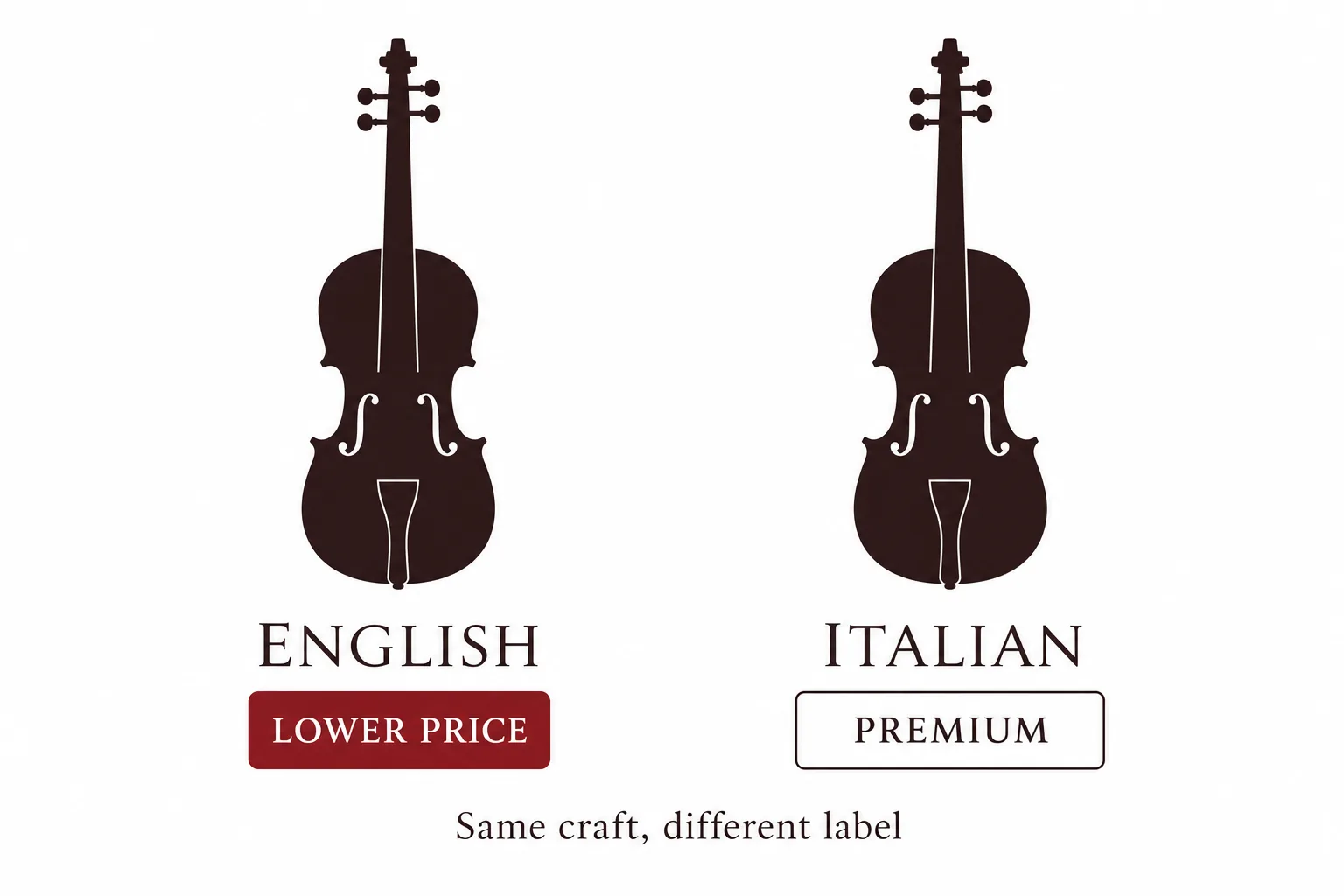
An undervalued instrument is priced below what its craftsmanship, condition, and sound would command if it carried a more fashionable label or country of origin. The wood is the same, the workmanship is the same, the sound under your ear is the same. What differs is the name on the label and the reputation attached to it.
That is the honest truth at the center of this subject: a violin’s price is driven by reputation and demand at least as much as by quality. Country of origin and maker fame move prices far more than most buyers expect. A well-marketed origin carries a premium; a quiet one does not. You cannot outsmart that in an afternoon, but once you see it clearly, you can shop for value instead of shopping for a story.
A word on value itself, because I want to be straight with you. When a good shop gives you a valuation, that is an informed professional opinion based on condition, quality, authenticity, and what comparable instruments are actually selling for. It is not a guaranteed resale figure, and no honest appraiser will promise you a specific future price or return. Think of any violin, whether a modest workshop instrument or one of the truly fine violins that come along now and then, as an instrument first. Institutions that steward great collections, like the Metropolitan Museum of Art’s department of musical instruments, catalog these objects for their craftsmanship and history, not as securities. That is a healthy frame for a buyer, too.
A quick history of the English violin school
The English tradition is real, accomplished, and older than many buyers realize. Through the 18th and 19th centuries, makers in London and in provincial towns built instruments to a high standard, often modeling their work on the great Italian patterns while refining a sound of their own: warm, focused, and noble. England had an active concert life and a demanding market, and its best makers answered with serious work.
So why did the English school never pick up the mystique that surrounds the Italian names? Partly timing, partly marketing, partly the romance that gathered around a handful of Italian towns and makers over two centuries. The Italian story got told and retold until it became shorthand for greatness. The English story, just as grounded in real skill, was never sold the same way. That thin layer of myth, or the lack of it, is the root of the undervaluation you can benefit from today. Britain’s national collections, including the musical instruments held by the Victoria and Albert Museum in London, preserve a craft heritage that never quite translated into market hype.
The English sound and build
What do players notice when they pick one up? Usually a focused, warm tone with an even response across the strings, and construction that feels honest and solid rather than flashy. These instruments were built to be played night after night, and it shows in how they hold up. If you want to hear that character in practice, a fine English violin by William Robinson is a good example of the noble English sound makers refined by studying the classical patterns and quietly improving on them for the working musician.
The makers worth knowing

You do not need a famous Italian label to own a serious instrument. Several English makers produced work that stands on its own merits, and knowing a few names helps you shop with confidence.
The Voller Brothers
The Voller Brothers are renowned among people who know the English scene for exceptional craftsmanship and remarkably faithful work in the great classical patterns. Their instruments turn heads today purely on quality: the workmanship, the varnish, the response. When collectors and players talk about English work that rivals more celebrated origins, the Voller name comes up quickly, and it comes up because the instruments earn it.
James and Henry Banks
The Banks family holds a solid, respected place in the English school. Their instruments are known for clean quality and genuine playability, the kind of violin a working musician can build a career around. To see how that reputation reads in a specific instrument, look at a violin by James and Henry Banks and notice the craftsmanship once you know what to look for.
Beyond Voller and Banks
The English school runs deeper than two names. London and regional makers worked across different price levels, so there is real range here: honest, well-made English violin work at a modest budget and exceptional examples higher up. That variety is exactly why it pays to play several instruments side by side rather than chasing a single name. For a sense of the breadth, spend time with our collection of fine English violins, where you can see how much one English violin varies from another while still carrying that characteristic warmth.
Why English violins stay underpriced (the market forces)
A few forces work together, and none are mysterious once you name them.
Reputation and fashion. The Italian name commands a premium, full stop. French work, especially the well-organized output of the Mirecourt workshops, is also well marketed and widely recognized, so both historical and contemporary Mirecourt violin makers enjoy a recognition English makers never got. When buyers go looking for French violins for sale, they are partly buying a reputation that decades of trade built up. English work had less of that myth-building around it, and the price reflects the marketing gap, not a quality gap.
A thin, illiquid market. Fine instruments do not trade like stocks. They change hands slowly and infrequently, and fewer buyers actively chase English names, which keeps prices from being bid up. Anyone tempted to treat a violin as an investment should understand this the way the U.S. Securities and Exchange Commission describes liquidity risk for any hard-to-sell asset: you may not be able to sell quickly, or at the price you hoped, when you want to. That illiquidity is part of why English violins stay affordable, and it is also why you should buy one to play, not to flip.
Attribution and paperwork. Value hinges on authentication and condition. When documentation is thin or attribution is uncertain, the price drops to reflect that uncertainty. That is not always bad for a buyer who cares about sound more than provenance, but you should know what you are getting and what you are not.
Regional bias. Buyers gravitate toward origins they already know. It is human, and it quietly steers demand away from English work toward names that feel safer, which again keeps English prices reasonable for the player who knows better.
Which country makes the best violins?
I get asked this constantly, so let me answer it head-on: there is no single best country, and anyone who tells you otherwise is selling something. Italy earns its towering reputation honestly, but France, Germany, and England all produced instruments that rival the Italian schools. Germany’s Mittenwald tradition is a close parallel to the English story. A well-made Josef Klotz violin from that lineage can be historically fine and still underpriced for the same reasons English work is, because the market rewards fame over craft. The lower end of the German market raises its own questions, which we answer in our guide to trade-grade German instruments for serious players. The Klotz family and the wider Mittenwald school show that undervaluation is not unique to England; it follows any tradition that built beautifully but never got the marketing.
The practical answer is that the best violin is the one that suits your hands, your ear, and your budget. National collections such as those held by the Smithsonian Institution preserve masterworks from many countries side by side, and the lesson is the same: fame does not equal quality. That gap is precisely why English and certain German instruments are such genuine values.
The best violin is the one that suits your hands, your ear, and your budget. Fame does not equal quality.
How to judge an English violin before you buy
Understanding the market is half the job. The other half is evaluating an actual instrument, and this is where a good shop earns its keep. Here is a plain-language checklist.
Put condition ahead of the label. Cracks, past repairs, and structural health matter more than any name. A clean violin by a lesser-known English maker can be a far better buy than a compromised example of a famous one. Learn to ask about condition first.
Judge the sound under your own ear and hands. Play the instrument in a real room, ideally right next to comparable instruments so you can hear the differences. Recordings and descriptions only take you so far. Nothing substitutes for how a violin responds to your bow and your body, and English violins in particular reveal their warmth only when you play them.
Ask for honest attribution. A trustworthy shop will tell you plainly what is documented and what is a professional opinion. There is nothing wrong with an educated attribution, but you deserve to know the difference between certainty and informed judgment. If a seller blurs that line, be cautious.
Get a professional appraisal in writing. An appraisal is an informed opinion of value based on condition, quality, and comparable sales, not a price guarantee and not a promise of appreciation. Having it in writing protects you, helps with insurance, and gives you a clear-eyed sense of what you are buying. This is a core service any serious shop should offer, explained to you transparently.
Check the set-up and playability. How a violin is adjusted, the soundpost, the bridge, the strings, changes how it sounds and feels dramatically. A great instrument with a poor set-up can disappoint, and a good set-up can transform one. Ask what has been done and what could be improved.
That kind of hands-on, honest guidance is what you should expect when you walk into a shop, and it is the heart of what we do when we help someone choose or sell an instrument.
Value, condition, and the role of restoration
Most discussions of undervalued instruments stop at the market and skip what matters most day to day: condition and restoration are central to an English instrument’s real value and playability. An older violin that has been cared for, or sympathetically restored, can sing. The same instrument with clumsy past repairs is dragged down in both sound and value.
Good restoration is quiet, skilled work. Done well, careful violin repairs can unlock the potential inside an older instrument, stabilizing cracks, correcting a poor past repair, and getting the set-up right so the violin plays the way its maker intended. Done poorly, repairs do lasting harm. This is why the condition report and the quality of any prior work deserve as much attention as the label.
This is not only a violin question. Undervaluation runs across the whole violin family. Vintage cellos and well-made contemporary violas get overlooked for the same reasons English violins do: less fame, thinner demand, quieter marketing. The evaluation habits are identical whatever the instrument. Buy something you genuinely love to play, care for it properly, and treat any future value as a bonus rather than a promise.
Seeing English violins in person in the Mid-Atlantic
For these instruments especially, you have to play them. The value of an English violin lives in a sound and a condition you can only judge with the instrument under your chin, in a room, next to other options. No photograph or description settles it.
That is why an in-person visit matters. We are a brick-and-mortar shop serving players across Washington DC, Maryland, and Virginia, and the wider Mid-Atlantic including Delaware and Pennsylvania, so wherever you are in the region, coming in to try instruments is realistic. There is also a natural rhythm to upgrading. Many players do their serious shopping in the fall, roughly October through January, and again from May through late June, and those quieter stretches are ideal times to come in and take your time. You can compare several instruments without rushing, ask every question, and listen carefully before deciding.
What you get in person is the part that never comes across online: real experience with these instruments, an inventory you can actually put your hands on, and unhurried, personal attention while you figure out what fits you. That is the whole point of visiting a shop rather than buying from a screen.
Come play a few
If any of this has you curious, the next step is simple and low-pressure: book an appointment or stop by to play a few English instruments side by side, alongside French, German, and other options, so you can hear the differences for yourself. If you already own an instrument, come in for an appraisal and an honest, professional opinion of value, or talk through a repair or restoration that might bring an older violin back to life. No pressure and no script, just clear, transparent, expert help from someone who genuinely cares how you end up.
Once you find the instrument that fits, we can help you sort out the right case and bow to go with it when you visit. Those finishing touches are handled in the shop, in person, the same way we handle everything else: carefully, honestly, and with your playing in mind.