

Most players remember the first time they heard two good violins back to back. You draw the same bow, play the same passage, and something changes. One sounds rounder and more alive under your ear. The other feels quicker, tighter, easier to steer. You can hear the difference, but naming it is another matter. If you keep running into the phrase “Italian tone” while weighing an upgrade, this guide is for you. We will walk through how Italian and French violins actually sound different, why they sound different, and why “which one is better” is the wrong question to start with. No jargon, no mystique, just what we hear on the bench every day.
The Short Answer: What Italian and French Tone Actually Sound Like
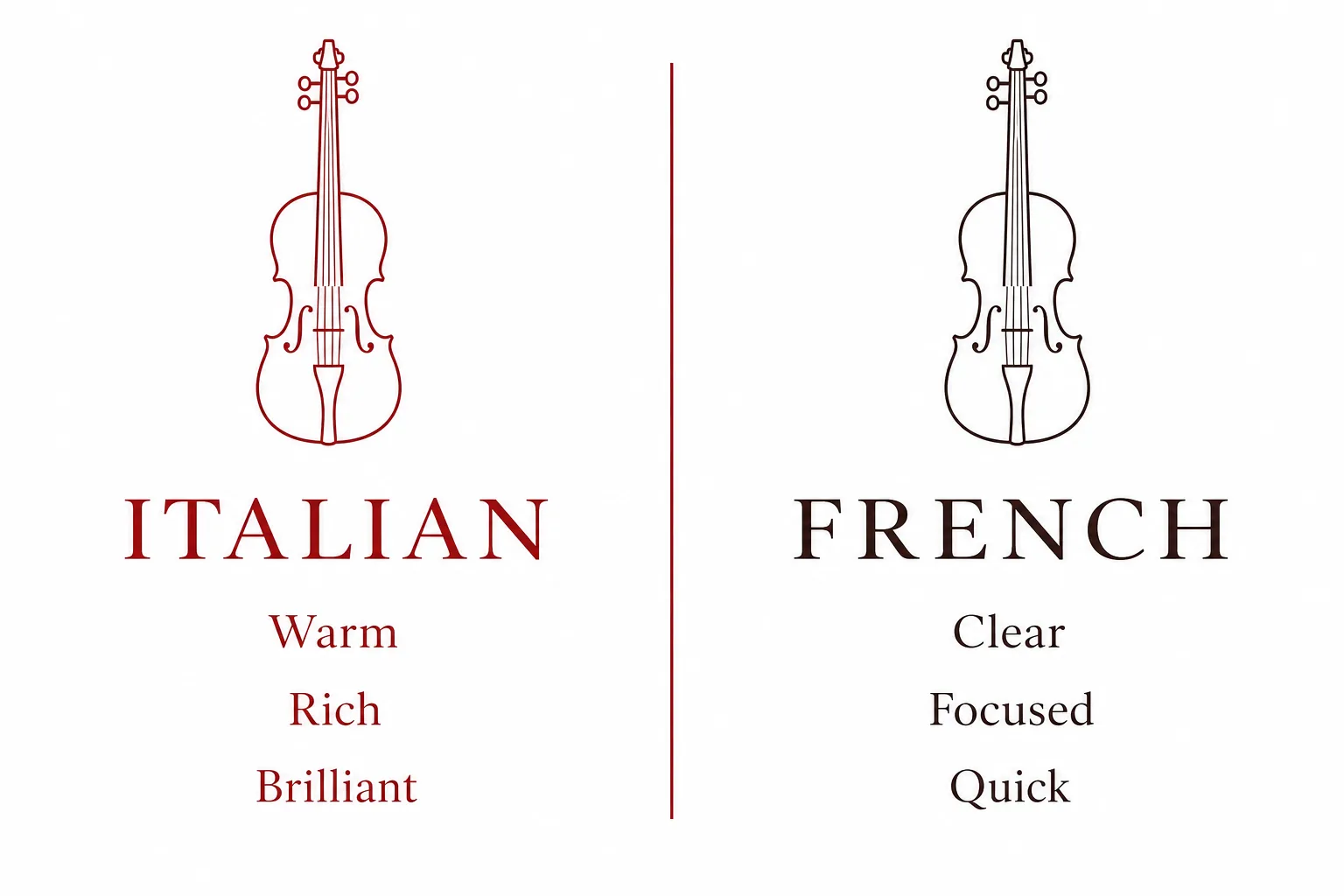
Here is the plain version, the way a player would describe it after an afternoon of trying instruments.
Italian violins are often described as warm, rich, and brilliant, with a complex sound that can feel big under the ear and carries well into a room. There is frequently a singing quality to the top string and a certain depth on the low strings that players call “chocolatey” or full.
French violins are more often described as clear, focused, and refined, with a slightly more nasal or reedy edge and an even response from string to string. Many players find them quick to speak, meaning the note starts the instant the bow bites, which makes fast passage work feel effortless.
Now the honest caution, and it matters. These are tendencies, not rules. A great French violin can out-sing a mediocre Italian one on any given day, and plenty of instruments do not read to type at all. The differences also get exaggerated in conversation. When researchers ran a careful blind listening test, published in a study in the Proceedings of the National Academy of Sciences, even experienced listeners could not reliably pick the celebrated old Italian instruments out of a lineup by ear alone. So treat the descriptions above as a starting map, not a guarantee. Your ears in the room are the real test.
Treat the descriptions as a starting map, not a guarantee. Your ears in the room are the real test.
Why They Sound Different: It Starts With How They’re Built
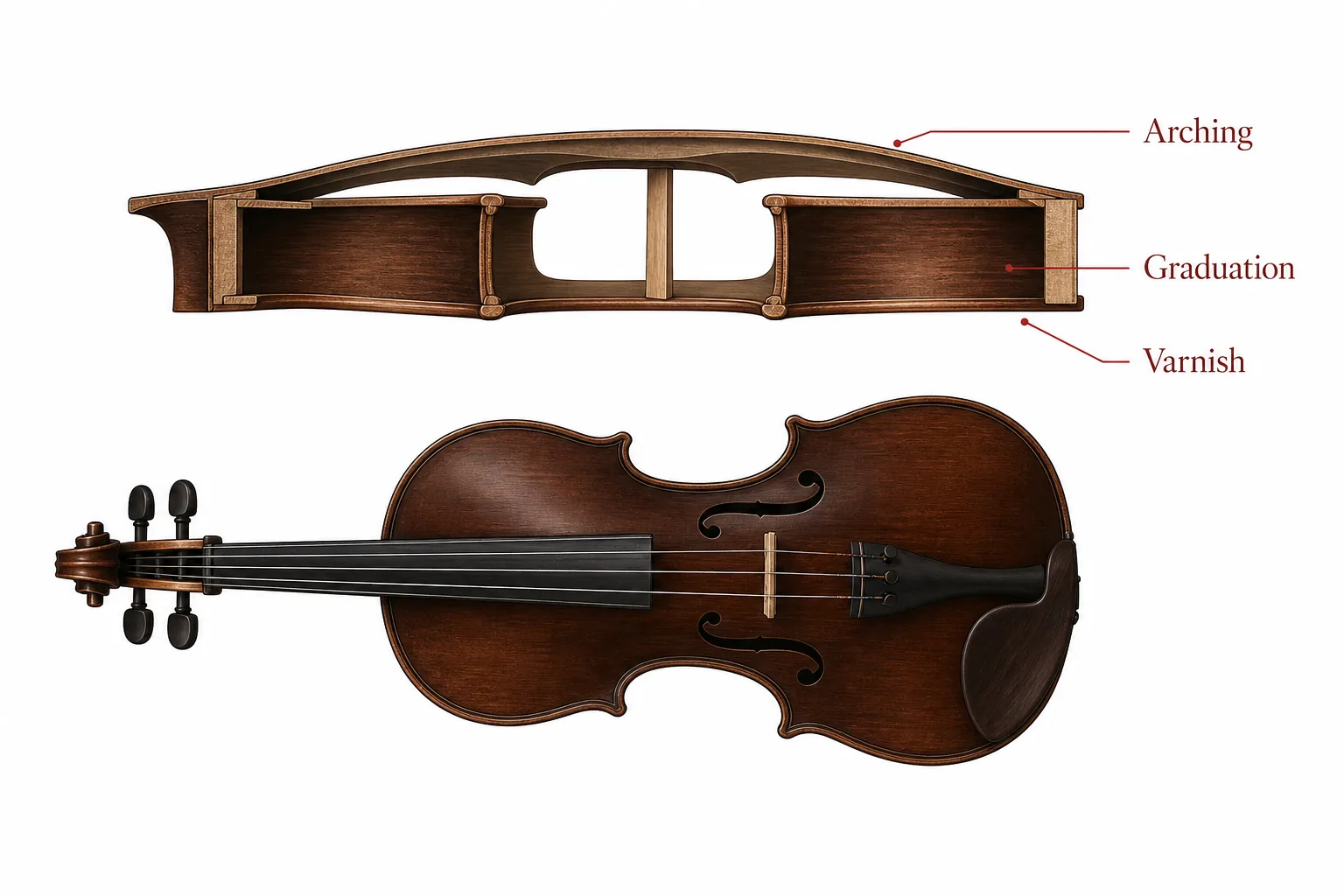
Tone is not magic. It is the physics of a wooden box vibrating, and the choices a maker makes about that box shape the sound. Three of those choices do most of the work.
Arching and Plate Thickness
The top and back of a violin are gently curved, and the height and shape of that curve, the arching, has an enormous effect on the sound. Classic French and Italian instruments were often built on the lighter side, with thinner plates and carefully judged arching. A flatter, lower arch tends to give more power and projection. A fuller, higher arch often gives a sweeter, more airy sound with a little less push. Makers in both traditions understood this, but they made different habitual choices about where to land. Age is a separate variable from national school, and our article on whether a violin’s age affects projection looks at how older and newer instruments fare in a full orchestra.
This is not guesswork by modern makers either. A study on the acoustic evolution of old Italian violins from Amati to Stradivari traced how the geometry of the great Cremonese instruments shifted over generations in ways that measurably changed their resonance. The shape you see when you look across the top of a violin is not decoration. It is the maker tuning the sound with a gouge.
Wood, Graduation, and Weight
How a maker distributes wood across the plates, called graduation, changes how the instrument responds and how warm it sounds. Leave the wood a touch thicker in the right places and you get strength and stability. Take it thinner and the top moves more freely, which can add warmth and quickness but asks for a lighter touch. A heavier build and a lighter build can both sound wonderful, but they will feel and sound different in your hands, and they suit different players. Someone who digs in hard for a big orchestral sound wants something different from a chamber player who lives on nuance.
Varnish and Setup
Varnish gets talked about like a secret ingredient. It does play a real part, mostly in how the wood is damped and how freely it vibrates, but it is easy to overclaim here, so we will keep it simple: varnish is one contributor among several, not the whole story. Setup matters just as much and often more day to day, since the soundpost, bridge, and strings can meaningfully shift how any violin speaks.
There is also a well-known visual quirk that gets tangled up with tone: some Italian makers varnished the inside of the pegbox, while French and German makers typically left it bare. That is a useful identification clue, but it is a visual tell, not a tonal one. A varnished pegbox does not make a violin sound Italian. If you want to see how much these choices add up in practice, it is worth studying the craftsmanship behind fine Italian violins up close, where the arching, wood, and finish all show the maker’s hand.
The Two Traditions: A Quick, Honest History
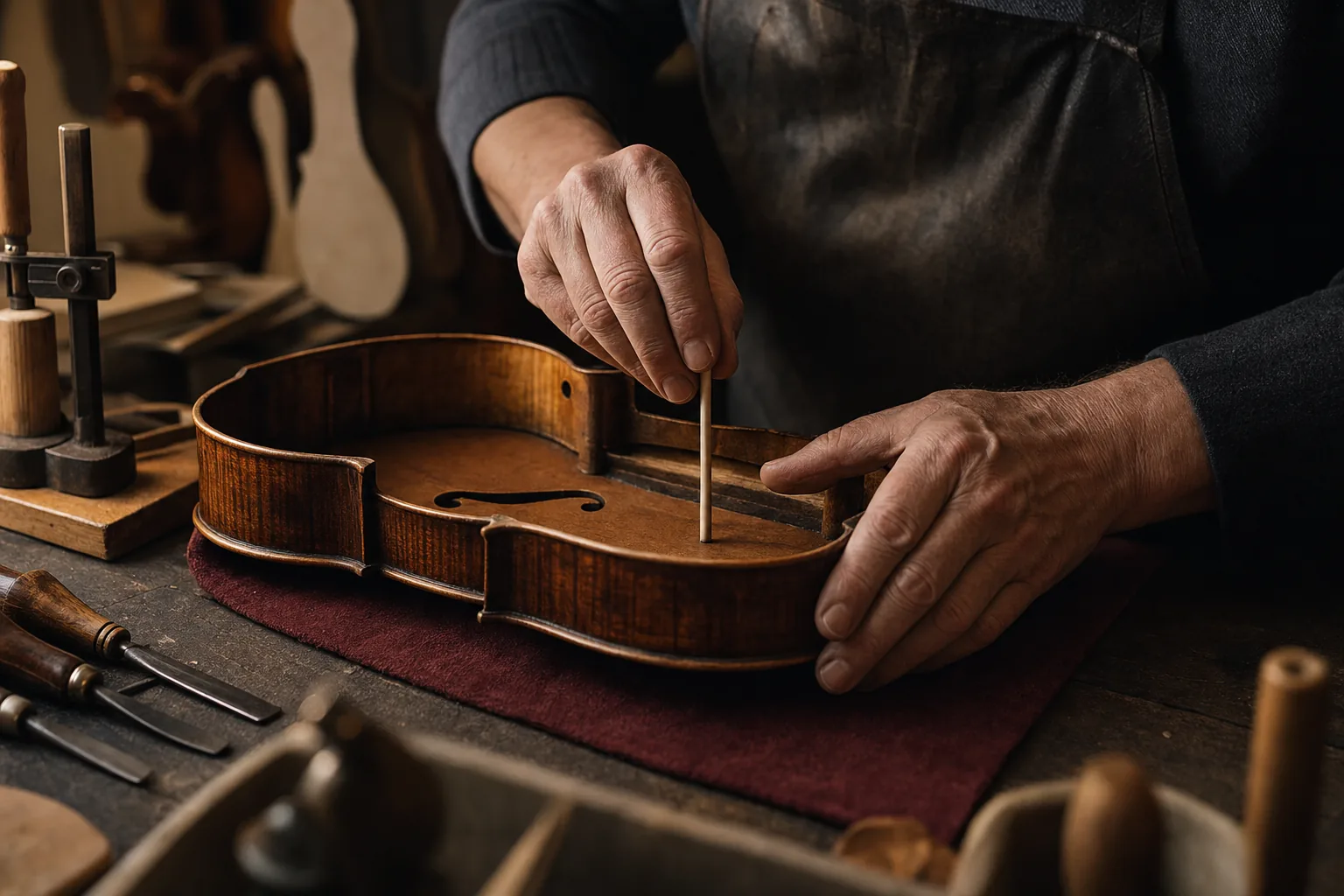
A little background helps the sound make sense.
Italy, and Cremona in particular, is where the golden-age violin sound was born. The great Italian shops built instruments largely one at a time, by hand, and each carries the individual character of the person who made it. That bench-made, one-off quality is a big reason Italian instruments vary so much and why the best of them feel so alive.
France took a different and equally admirable path. The workshops of Mirecourt and the Paris schools became renowned for refined, consistent, superbly finished work. Mirecourt in particular built a tradition of precision and repeatable quality that still shapes how French instruments are regarded today, and that tradition is very much alive: contemporary Mirecourt makers continue to turn out beautifully executed instruments, and good French violins for sale remain a smart hunting ground for players who want quality without an Italian price tag. The character that comes out of this tradition, clean, even, and elegantly finished, is exactly what many players mean when they praise a fine Paris-school French violin.
One more honest point for anyone shopping today. You do not have to buy something centuries old to get a wonderful instrument. When researchers had accomplished soloists compare six old Italian and six new violins in a blind setting, the players did not systematically prefer the old masters, and several favored the new instruments. Fine modern French and Italian violins compete seriously with historic ones. That is good news for your budget and your options.
“Which Country Makes the Best Violins?” Answering the Real Question
This is the question everyone eventually asks, so let us answer it straight. There is no country that makes “the best” violins in a way that helps you choose an instrument. The best violin is the best violin for you: for your playing, your hands, the rooms and ensembles you play in, and your budget.
German instruments deserve a mention here too, because players often lump the comparison together as Italian versus French versus German. German shops produced enormous numbers of well-made instruments across a wide quality range, from workmanlike trade violins to genuinely fine work. We explain how to spot the better examples in our piece on buying a German trade instrument. Telling a German instrument from an Italian one comes down to small differences in the body outline, the f-hole shape, the finish, and construction details rather than any single giveaway. The point is that country of origin is a clue to style and history, not a grade.
This is also where we want to be honest about value, because it is easy to get sold a nationality instead of an instrument. A violin’s worth rests on its maker, its condition, its quality, and its provenance, not on the flag on the label. We describe value as an informed, professional opinion, and we will never tell you an instrument is guaranteed to appreciate or resell for a certain figure. Anyone who promises that is selling you a story. What we can do is help you understand exactly what an instrument is and what it is worth today, plainly and honestly.
How to Actually Hear the Difference: A Player’s Test-Drive Method
Most articles will describe the sound and stop there. That does not help you when you are standing in a shop with two violins and a decision to make. So here is a repeatable way to hear the difference for yourself.
- Play the same thing on each. Pick a short passage you know cold, ideally one with both a lyrical line and something faster. Playing identical material removes the biggest variable, which is you.
- Listen under the ear, then from across the room. What sounds biggest under your chin is not always what projects. Have a friend or a shop staffer play while you stand fifteen feet away. Italian instruments in particular can sound very different out in the room than they do under your ear.
- Test evenness across all four strings. Play a scale that crosses every string and listen for any that jumps out louder, weaker, or with a different color. French instruments are often praised for evenness, but every individual violin is its own case.
- Test quick response versus sustained response. Try short, articulate notes to feel how fast the instrument speaks, then long sustained notes to hear how the sound blooms and holds.
- Bring your own bow, and play in a real acoustic. Your bow is half of your sound. Testing with an unfamiliar bow adds a variable you do not need.
One finding is worth keeping in mind as you do this. When researchers studied player preferences among new and old violins, how an instrument felt and responded under the hand drove player choice at least as much as tone did. That matches what we see every day. People fall in love with how a violin plays, not just how it sounds on a recording. Response depends partly on setup and on a well-matched bow, which is why a slightly disappointing instrument sometimes just needs the right adjustment or the right stick to come alive.
How to Identify a French Violin (Visual Tells)
If you want to recognize French work by eye, here are the accessible cues, kept simple.
- F-hole shape. French f-holes, especially from the Mirecourt tradition, tend toward a clean, elegant, consistent cut. The exact shape is one of the most telling signatures of a school or a maker. For the Italian side of that comparison, our guide to spotting the hallmarks of Cremonese training walks through what to look for.
- Workmanship and finish. French trade instruments are often notable for tidy, precise, well-executed work. That crisp, orderly look is itself a clue.
- Varnish cues. Color and texture of the varnish, and how it was applied, differ from region to region. And remember the pegbox tell: a bare, unvarnished pegbox interior points away from Italian work.
- Labels and branding. Some French workshops branded the instrument itself in addition to a paper label. But treat any label with healthy skepticism, because this is exactly where things go wrong.
That last point deserves emphasis. Labels lie, constantly. A label inside a violin is a claim, not proof, and misleading labels have been common in the trade for a very long time. Real identification is a skill built from handling many instruments and knowing where each maker’s hand shows up, in the scroll, the corners, the f-hole cutting, the varnish. You can see how personal it gets when you study the maker-specific details in an individual violin, where the scroll work and f-hole cutting reveal one specific person’s habits. This is precisely the kind of thing best confirmed in person by someone who examines these instruments daily, which is a large part of what a careful appraisal is for.
Labels lie, constantly. A label inside a violin is a claim, not proof.
Does It Matter for Cellos and Violas Too?
Everything above is written about violins, but the same tonal-tradition ideas run right across the family. The Italian and French schools shaped violas and cellos with the same instincts about arching, wood, and finish, so the broad character tendencies carry over. If you are considering a cello or a viola, the same advice applies: listen for warmth versus focus, test the response, and judge the individual instrument rather than the label. We handle the whole violin family, violins, violas, cellos, and bows, so these comparisons are part of everyday conversation in the shop.
What This Means When You’re Upgrading
Here is the takeaway if you are stepping up from a commercial student instrument to your first genuinely fine violin. Do not buy a nationality. Buy the individual instrument that fits your voice, your hands, and the music you actually play. Italian and French are useful signposts for the kind of sound you might gravitate toward, but the violin in front of you is what matters, and instruments vary far more within a country than the stereotypes suggest.
The single most valuable thing you can do is try many instruments side by side, with someone knowledgeable helping you hear what you are hearing and asking the right questions about how you play. That is where good guidance earns its keep, and it is also where honest repair work and a clear-eyed appraisal fit in, so you understand an instrument’s condition and value before you commit. Buying is the heart of it, but all of that care is part of the same job: helping you land on the right instrument with your eyes open.
If you are planning a visit, the calmer stretches of the year tend to be fall, roughly October through January, and late spring, around May into June. Those are lovely windows to sit with several instruments without rushing.