
Almost every player who comes in asking for “more sound” tells the same story. You are sitting in the section, the brass is up, the conductor asks for more, and the violin that sounded glorious in your practice room is not getting out into the hall. That frustration starts the antique versus modern search, usually with the assumption that older means louder.
The old vs new violins debate is exactly that search, dressed up in more technical language.
After years of handling, adjusting, and selling instruments of the violin family, here is the honest version: age is one of the weakest predictors of how well a violin carries. Below is how projection actually works, what each era offers a working orchestral player, and how to test an instrument before you commit to it.
Quick take: antique vs modern violin for orchestral projection
This guide is written from Washington Fine Violins’ experts in Washington, DC, drawing on more than 25 years of hands-on instrument evaluation, sales, and appraisal work.
What Orchestral Projection Actually Means (And Why It Isn’t Loudness)
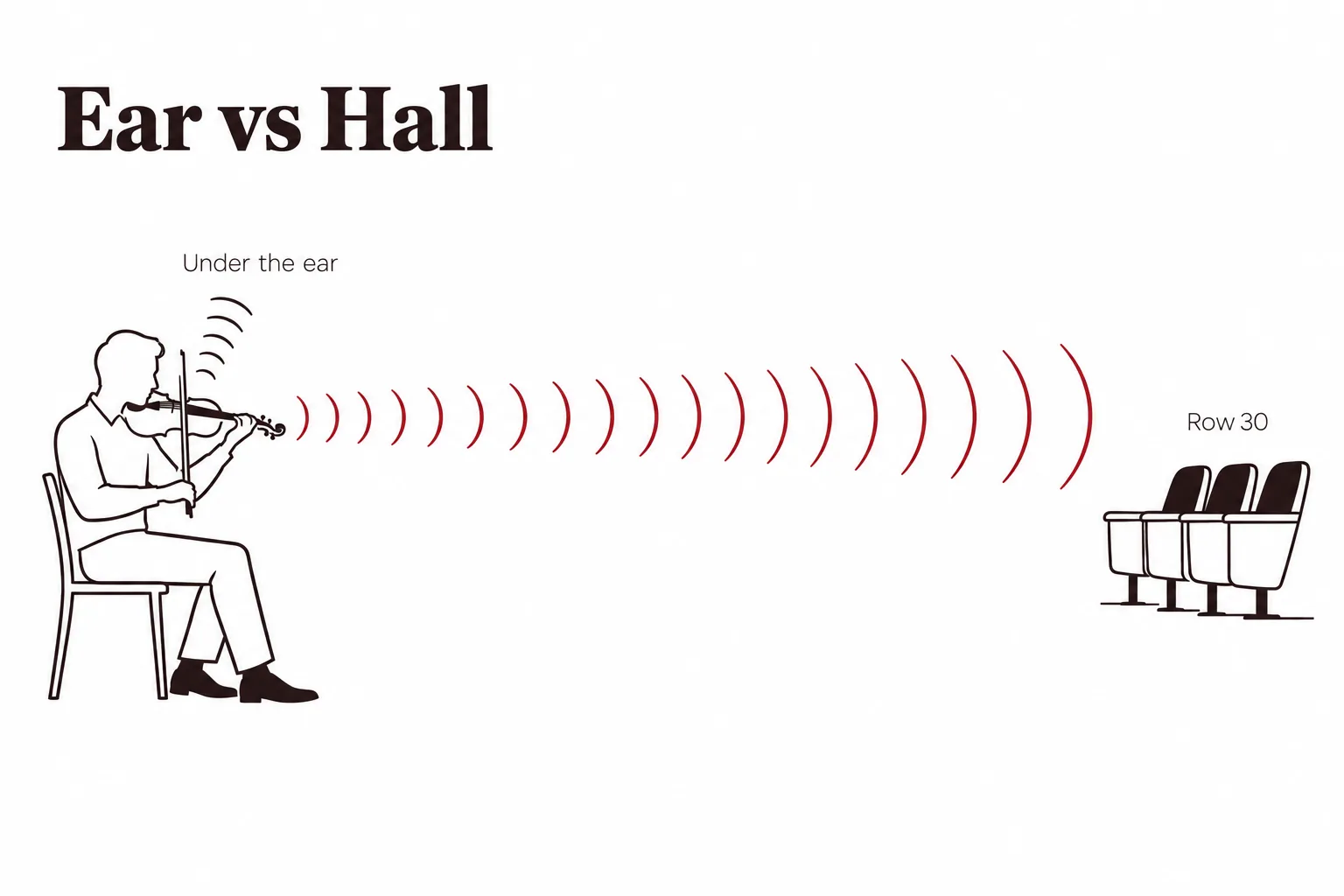
Projection is carrying power: how much of your sound reaches row 30, and how much of it survives being surrounded by fifteen other violins, a woodwind section, and a brass section playing full out. That’s the working definition of violin sound projection used throughout this guide: carrying power at distance, not loudness under the ear.
It is not the volume you hear with your left ear six inches from the instrument.
That distinction is the most expensive misunderstanding in violin shopping. A violin can feel enormous under the ear and then go flat and small at distance, because much of what you hear is radiating up into your face rather than out into the room. The reverse happens just as often: the instrument that feels almost polite to play is the one heard clearly at the back of the hall.
Under-ear impression and hall presence are two different measurements, and only one of them matters when you are being paid to play.
Orchestral players need three things, and they pull in slightly different directions:
- Presence. Being heard through dense scoring without forcing the bow.
- Blend. A sound that sits inside a section rather than sticking out of it. A violin that thrills as a solo instrument can be a liability in a unison passage.
- Clarity in soft playing. Projection at a whisper is harder than projection at full volume, and it is where many otherwise strong instruments fall down.
One thing to hold onto before comparing eras: projection is not a number stamped on the label. It is the instrument, the setup, the strings, the bow, and the player working together. Change any one of them and the carrying power changes with it.
The Old-Is-Better Myth, Honestly Addressed
Age alone does not make a violin better. Every era, including the celebrated ones, produced instruments across the whole quality range: a handful of extraordinary ones, a great many good working instruments, and plenty of ordinary trade fiddles. A violin that was ordinary in 1780 is still ordinary. It is just older.
This is not only a shop opinion. In blind trials, experienced violinists tended to prefer playing new violins over Old Italians and could not tell new from old at better than chance levels. On the exact question that brings most people here, a concert hall listening study found that the new violins projected better than the Stradivaris, with orchestra and without, and the listeners could not reliably tell which was which.
So why does the myth survive? Reputation compounds. Great soloists record on historic instruments, so the sound of a historic instrument becomes the reference sound in everyone’s ear. Auction results make headlines, and price gets read as proof of quality. And there is real romance in holding something that has been played continuously for two hundred years, which nobody should be talked out of enjoying.
What fine antiques genuinely offer is worth taking seriously, and it is coming next. What they do not offer is an automatic advantage in carrying power. If you audition a modern violin against an older one and prefer the modern instrument, that is not a compromise and it is not an untrained ear. It is a normal, well-supported outcome.
The Research Behind It: What the Old Italian vs New Violins Studies Actually Found
The research behind the claims above comes from a team led by Claudia Fritz, a researcher at Paris’s Institut Jean Le Rond d’Alembert, working with American violin maker Joseph Curtin. Their first blind trials had experienced violinists play both old and new instruments without knowing which was which. Players could not reliably tell old from new, and on average preferred the new instruments.
The projection-specific test, published in the Proceedings of the National Academy of Sciences, went further. It moved the question out of the practice room and into a concert hall, testing violin projection with orchestra as well as without, once in a small hall near Paris and again in a larger New York City hall. Listeners, not just players, judged which violin carried.
The new instruments projected better in both settings, were generally preferred, and listeners could not reliably identify which violins were old and which were new.
That’s the actual evidence behind everything in this guide. It’s not a shop opinion dressed up as research, it’s a repeated, peer-reviewed result.
How Fine Antique Violins Behave in a Section
The honest case for a good antique is character, not raw output. Older instruments often have a depth and complexity to the sound, a layered quality where the note is not one clean tone but a small stack of colors. Players call it maturity, or a lived-in response, and it is not imaginary. It shows up most clearly in how the instrument answers small changes in bow speed and contact point. You shade a phrase without doing anything obvious, and the violin does the rest.
Orchestrally, that pays off in specific places. In an exposed passage where two or three of you carry a line, color is what makes the moment. Inside a string section, a warm, slightly complex sound tends to blend beautifully rather than cutting across the players beside you. In chamber work, which most orchestral players also do, that tonal depth is worth a great deal.
The limitation deserves equal honesty. In our experience, only the top tier of historic Italian work projects effortlessly over heavy orchestration, and those instruments trade in a market most players will never shop in. Many genuinely good, genuinely charming antiques are simply not loud. They were built for smaller rooms, smaller ensembles, and lower tuning. Asking one to compete with a modern brass section at full tilt is asking it to do a job it was never built for.
Shopping in this range, you will meet Italian work of many periods (a Milan violin, or a twentieth century instrument by a maker such as Giuseppe Lucci), French instruments, English violins, and the enormous output of the German trade. Buyers often arrive with one name in hand, sometimes after hearing a colleague’s instrument and deciding to purchase French violins, sometimes asking after a particular maker such as Filippo Anselmi or Charles Coquet. A name is a starting point, not a shortcut. Within every school the range from workshop instrument to fine individual work is very wide, and the violin in front of you outranks the label every time.
Condition matters more than age, and this is where experienced hands earn their keep. Old repairs, a past soundpost crack, an over-thinned top from an earlier restoration, badly fitted patches: all of these change how an instrument speaks, and all of them affect value. Some are entirely acceptable and correctly priced. Others quietly explain why a promising violin does not carry. The same logic applies to violas and to vintage cellos, so low string players can use this whole framework as written.
How Modern Violins Behave in a Section
Contemporary makers have an advantage the classical makers did not: they know exactly what their instruments will be asked to do.
New violin projection isn’t an accident of modern materials, it’s a stated design goal contemporary makers build toward from the first cut of wood.
They build for large modern halls, modern pitch, modern string tension, and orchestras louder than anything the eighteenth century assembled. Wood selection, arching, and how thickly or thinly the plates are carved are all chosen with hall output as a stated goal.
The practical result, in trials and on the shop floor, is usually immediate response under the bow, even power across all four strings without a weak spot on the G or a shrill patch on the E, and enough top end to cut through dense scoring. When an advancing student steps up from a commercial student instrument, the jump in responsiveness from a well-made modern violin is often the thing that changes their playing fastest. Our collection of modern violins from 1950 to the present exists largely because these instruments do this job so well.
Three more advantages are worth weighing:
Stability. Newer wood and fresh, sound assembly generally cope better with swings in humidity and temperature. If you play outdoor summer festivals, tour, or simply live with Mid-Atlantic summers and dry winter heat, that matters more than it sounds. A three hundred year old top that has already been through everything can turn sluggish exactly when you need it, and old glue joints complain first.
What the money buys. A strong instrument by a fine living maker typically costs a fraction of an antique that sounds comparable, because you are paying for sound rather than for scarcity and history. For a working player, that difference frequently funds a serious bow, which can change your sound as much as the violin does.
Certainty. The maker is alive. Provenance is unambiguous, no attribution question hangs over the instrument, and adjustments can be discussed with the person who built it. Anyone who has watched a friend agonize over a disputed old label knows what that peace of mind is worth.
One fair caveat: a brand new violin usually changes over its first years of serious playing, and most players feel it settles and opens as the setup beds in. Judge it on how it sounds now, not on what it might become.
Side by Side: Antique vs Modern on the Factors Orchestral Players Care About
| Factor | Antique | Modern |
|---|---|---|
| Raw projection in a large hall | Advantage only at the top historic tier, most antiques do not lead here | Advantage generally, confirmed by the hall research above |
| Tonal complexity and color | Where fine antiques earn their reputation | Clean and even, less layered under a microphone |
| Blend vs. individuality | Blends more sympathetically inside a section | Clearer individual voice, an asset for principal players |
| Climate and travel | More sensitive to humidity and temperature swings | The easier partner for touring and outdoor work |
| Price for equivalent sound | Pays for maker, rarity, and history as much as tone | Wins clearly, you’re paying for sound |
| Maintenance | Needs more attentive, more frequent professional care | Lower maintenance overhead |
| What you can actually try | Fewer instruments exist in any given range | Far more options to compare in one afternoon |
Add it up and the conclusion is unglamorous: the era predicts projection less reliably than the specific instrument in your hands.
Shop for the violin, not for the century.
What This Means for Violas and Cellos
Everything above holds for violas and cellos, with one wrinkle each.
Violas carry their own projection problem that has nothing to do with age: a viola’s body is acoustically too small for its pitch range no matter who built it or when, which is why viola projection depends even more on setup, string choice, and player technique than a violin’s does. An old viola and a new one both fight the same physics.
Cellos project differently in a section because the instrument sits lower in the texture and blends by design rather than cutting through it, so “does it carry” matters less than “does it lock in with the rest of the section” for most orchestral cellists. Solo and principal cellists should weigh carrying power the same way violinists do above.
The buying advice doesn’t change: test in a real room, with your own section mates if you can, and let the individual instrument decide rather than the label or the birth year.
Setup: The Cheapest Projection Upgrade Most Players Skip
Before deciding your instrument lacks power, rule out the possibility that it is not set up to deliver what it already has. We see this constantly, and it is often the difference between a frustrating violin and a perfectly good one.
- Soundpost and bridge. The small dowel inside the instrument, and the fit and thickness of the bridge, have an outsized effect on carrying power. A millimeter of soundpost movement can change how a violin speaks more than moving between eras will.
- Strings and tailpiece. String choice shifts the balance between how comfortable the violin feels under your ear and how present it is in the room. Those are not the same target, and plenty of players optimize for the wrong one without realizing it.
- The bow. A bow that draws sound differently adds or subtracts a surprising amount of apparent projection. Two bows on the same violin in the same hall will not carry the same way.
- Neglected maintenance. Open seams, a lifting fingerboard, worn pegs, and small unaddressed cracks quietly cost volume. Straightforward violin repairs and restoration work recover sound that was there all along.
| What you’re noticing | Likely cause | What to check first |
|---|---|---|
| Loud under the ear, disappears at distance | Soundpost or bridge fit | Have a luthier check soundpost position and bridge cut |
| Weak or muffled on one string | String choice or soundpost angle | Try a different string set before assuming the instrument is the problem |
| Feels great alone, gets lost in a section | Blend, not projection | Test in an actual rehearsal, not solo |
| Response feels sluggish or delayed | Neglected maintenance or old strings | Check for open seams, worn pegs, and string age |
A setup check costs a fraction of an instrument purchase, and it occasionally ends the search entirely.
How to Test Projection Properly Before You Buy
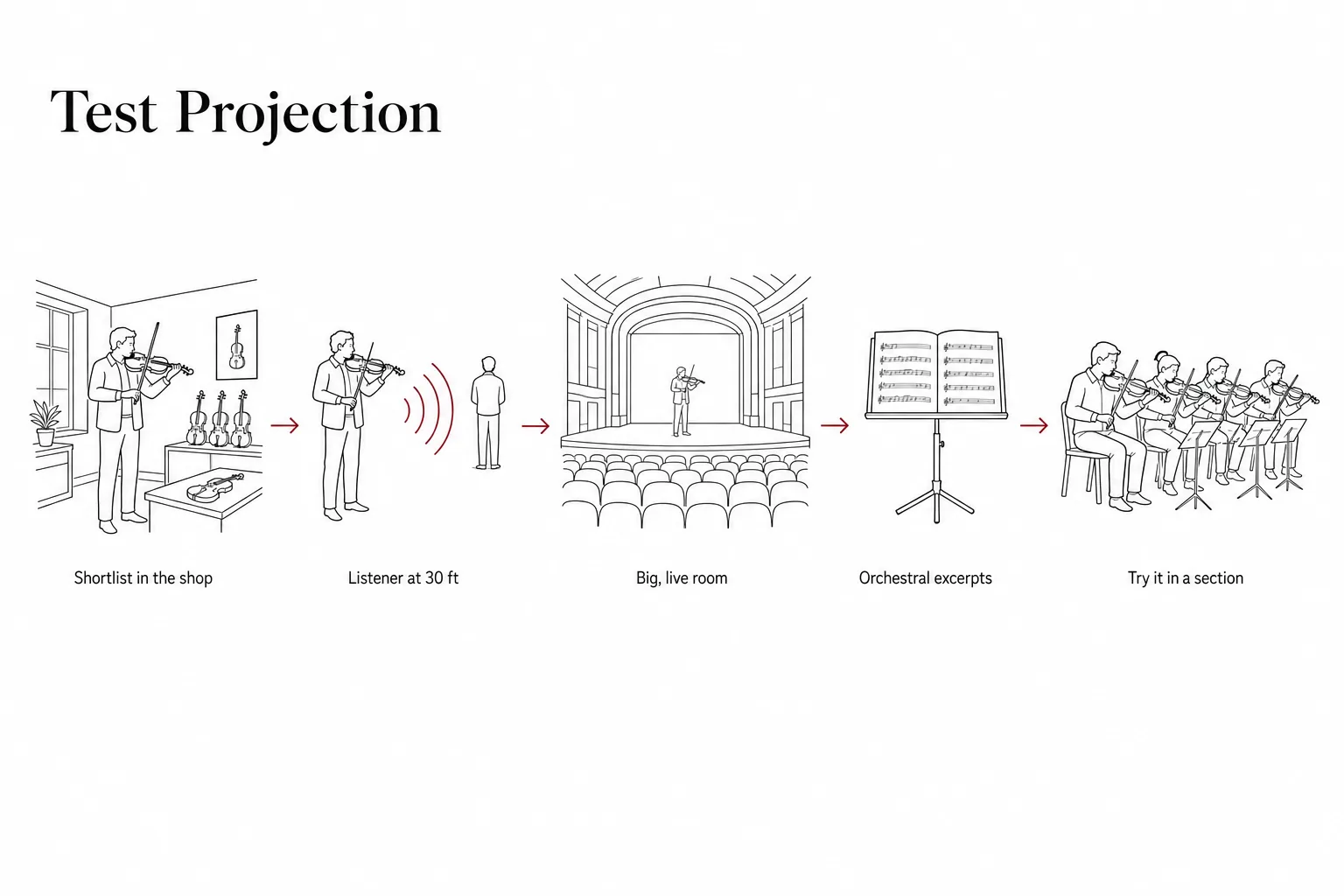
This is the part most buyers rush, and the part that decides whether you are happy in five years. Work through it in order.
- Play the candidates in the shop, but treat that as a shortlist tool. A shop room tells you about response, evenness, and comfort. It tells you very little about carrying power.
- Bring a trusted listener and swap places. Have a colleague or teacher play each instrument while you stand 30 feet away with your back turned, then reverse. Ten minutes here will contradict some of your under-ear impressions, which is the point.
- Get into a large, live room. Ideally a hall you actually perform in. Rehearsal rooms flatter everything.
- Play orchestral excerpts, not showpieces. Play the repertoire you are hired to play, including the quiet passages. Projection at a soft dynamic separates instruments faster than anything else.
- Test in a real section if the trial allows it. Sitting inside a rehearsal answers the blend question no solo test can.
- Compare against your current instrument, with your own bow, over several days. Ears change with fatigue, weather, and mood. Take short written notes after each session so you compare observations rather than memories.
| Step | What it actually tells you | Common mistake |
|---|---|---|
| Play candidates in the shop | Response, evenness, comfort | Mistaking this for a projection test |
| Swap places with a listener at distance | How it actually carries, not how it feels under the ear | Skipping this and trusting the shop-room impression |
| Test in a large, live room | Real hall behavior instead of a flattering rehearsal room | Testing only in a small, dead room |
| Play orchestral excerpts at soft dynamics | Where weak instruments actually fall apart | Only playing showpieces at full volume |
| Sit inside a real section | The blend question, which a solo test can’t answer | Judging blend from a solo audition alone |
| Compare over several days with your own bow | Removes fatigue and mood as variables | Deciding after one session |
Ask about trial terms and insurance coverage before you take an instrument out. Any shop worth buying from will explain both clearly and without pressure.
Matching the Instrument to Your Actual Playing Life
The right answer depends on the job the violin has to do.
| Playing life | What matters most | Leans toward |
|---|---|---|
| Section player who also teaches | Stability, evenness, durability under daily use | Modern |
| Regular exposed solos or chamber work | Tonal complexity and color | Antique, budget permitting |
| Advanced student preparing auditions | Immediate response under nerves | Modern |
| Frequent travel, outdoor gigs, humidity swings | Climate stability | Modern |
On budget, the same number buys different things in each direction. In modern instruments it buys the strongest sound available at that price, often from a maker you can name and contact.
In antiques it buys history, character, and the market’s regard for the maker, sometimes with less raw output than the modern alternative. Neither is correct in the abstract. Decide on sound and fit first, and let the era follow.
Value, Appraisal, and the Question Everyone Asks About Resale
An appraisal is a professional, informed opinion of value, based on the maker or school, condition, provenance and documentation, and what comparable instruments are actually doing in the current market. It is a considered judgment, not a price tag handed down by the instrument itself.
Be skeptical of anyone who promises more. No shop can guarantee a future sale price, a resale return, or a rate of appreciation, and we will not pretend otherwise. What we can do is tell you honestly what an instrument is, what condition it is in, and what that combination is worth today.
Condition and documentation drive value on both sides of the antique and modern divide. Clean, well-executed restoration work and a clear paper trail support value; undisclosed damage and shaky attributions undermine it. Keep your certificates, receipts, and repair records together, and keep them current.
Consignment and trading up are a normal part of a long playing career, and planning for that from the start makes each step easier.
Frequently Asked Questions
Related readingItalian vs. French Violin Tone: The Real DifferenceRead the guide →Frequently asked questions
Do antique violins project better than modern violins in a large orchestra?
What do players on forums and Reddit generally conclude about old versus new?
How much should I expect to spend on a violin that projects well in an orchestra?
Does a violin really open up and get louder the more it is played?
Are French, English, or Italian antiques a better bet for orchestral work?
Will a modern violin hold its value the way an antique does?
Should I upgrade the violin or the bow first?
Come Try Them Side by Side in the Shop
Everything above gets easier once you stop reading and start playing. The most useful hour you can spend is a back-to-back comparison: an antique and a modern instrument, your own bow, a listener at the far end of the room, and honest conversation about what each one is and what it costs.
We are a brick and mortar shop serving Washington DC, Maryland, Virginia, and the wider Mid-Atlantic including Delaware and Pennsylvania, and we work with players across the country. Alongside sales we appraise, buy, consign, repair, and restore instruments of the violin family, so if the answer turns out to be a setup adjustment or a repair rather than a new instrument, we will tell you that.
One practical note on timing: October through January and May through June are our busiest stretches for auditions and season planning, so booking ahead of those months gives you unhurried time in the room. Once an instrument is chosen, we will help you sort out a case and bow here in the store.