

Quick Take: How to Identify a Cremona School-Trained Violin
- To identify a Cremona school violin, work through the evidence in order: the label, the workmanship, the wood and varnish, the interior, and documentation. The label alone proves nothing.
- “Cremona school” actually covers three different things: rare historic instruments from the 1500s to 1700s, modern instruments by Cremona-trained makers today, and factory violins simply stamped “Cremona” with no real connection to the city.
- A label reading “Stradivarius” or “Cremona” is almost always a model name or a marketing word, not a maker’s signature. Genuine attribution never rests on the label alone.
- For higher-value instruments, dendrochronology, tree-ring dating of the wood, can support or rule out an attribution, alongside a certificate from a recognized expert.
- No single feature settles the question. Identification is a stack of evidence, and the only reliable way through it is an in-person examination.
What “Cremona School” Actually Means
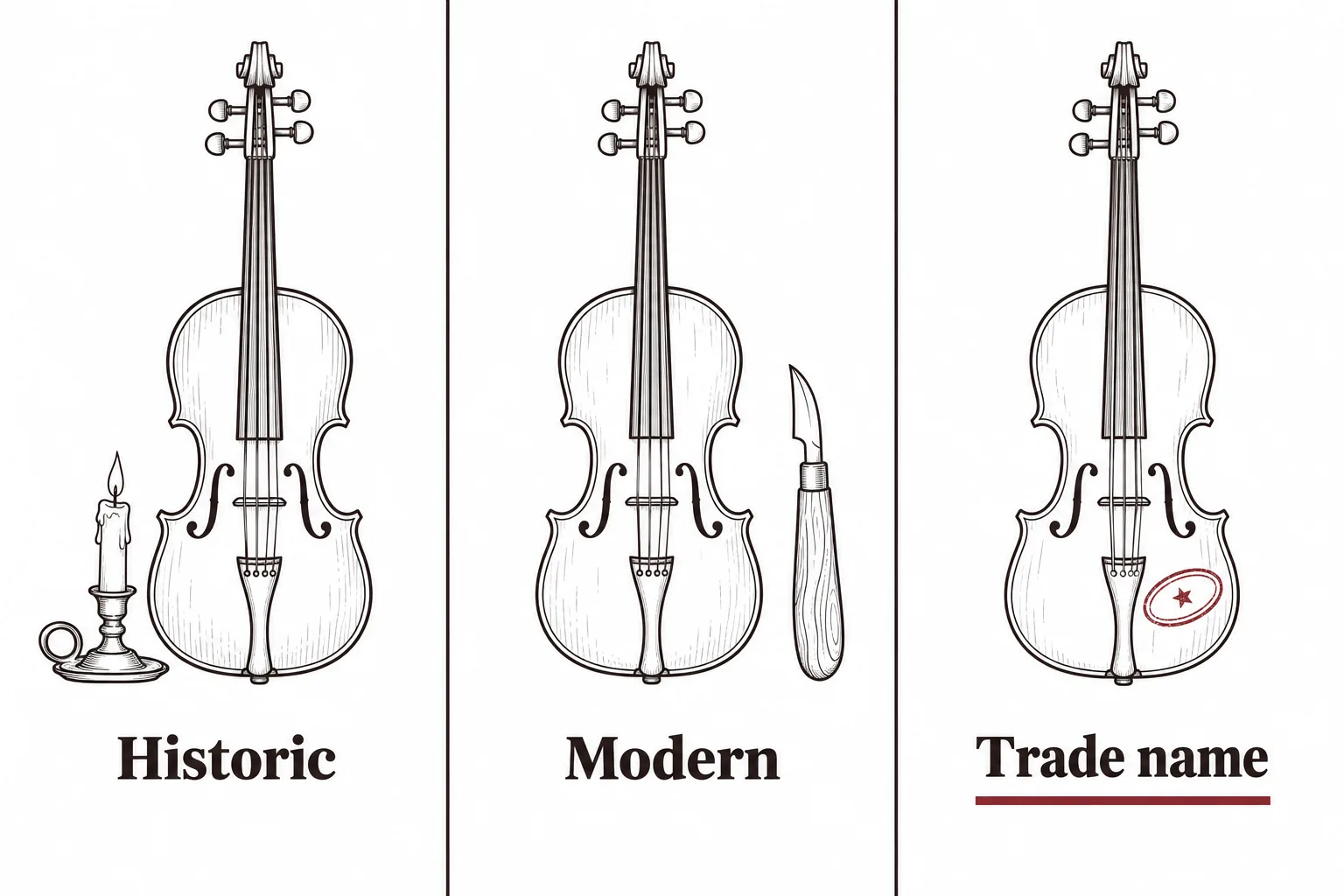
That phrase gets used to describe three different things, and figuring out which one you’re holding is the whole ballgame.
| Category | What it is |
|---|---|
| Historic Cremonese | Real instruments built by hand in Cremona in the 1500s through the 1700s, during the era that set the standard the rest of the violin world still follows. Exceptionally rare and valuable, and almost every surviving example is already known and documented. |
| Modern Cremonese | Instruments built today by makers trained at Cremona’s own violin-making school, still handmade in the city using the same traditional methods. A genuine, honest step up for a serious player. |
| “Cremona” as a trade name | By far the most common: a stamp or printed label reading Cremona on a mass-produced factory violin, with no real connection to the city at all. |
Which of these three you’re actually holding changes everything else in this guide. That historic-versus-modern question isn’t unique to Cremona, either. It’s the same trade-off a lot of players weigh when comparing an antique vs. modern violin for orchestral projection generally, old craftsmanship against new, consistent construction.
Step 1: Read the Label, Then Set It Aside
Labels are easy to copy, and they were copied constantly. A label reading Stradivarius with a printed date almost always means the shape was copied, not that Stradivari made it. Distributor names and generic Cremona stamps point to instruments sold through retailers rather than made by hand in Italy.
Genuine modern Cremonese work usually carries the maker’s own label with name, city, and year, often hand-signed or brand-stamped inside. Note the paper tone, the printing, the glue, and whether the label has been replaced. Then set it aside. Real ambiguity is normal, as with a mid-century European violin carrying a well-known Italian name whose actual maker is unknown.
Step 2: Look at the Workmanship
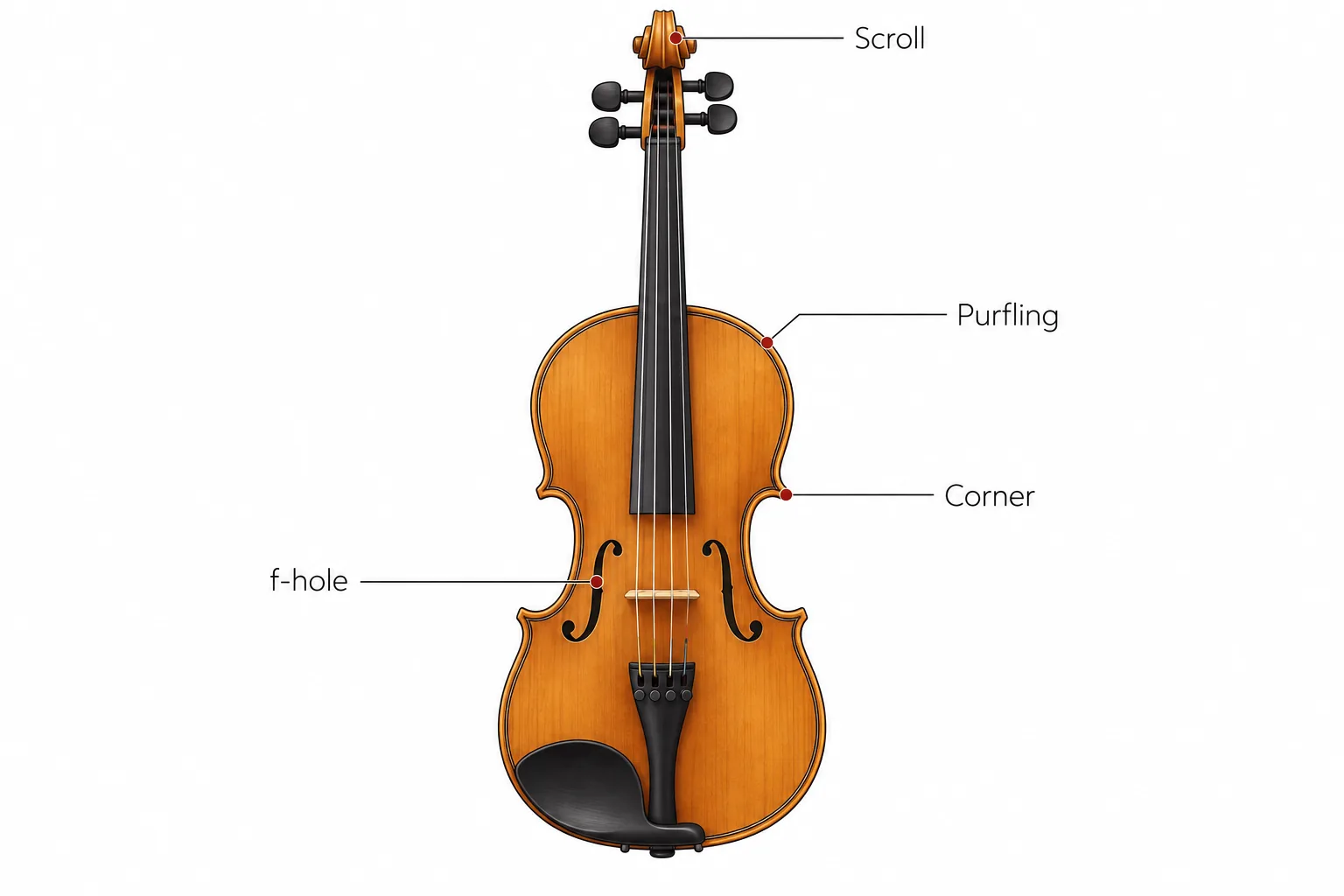
Use strong light raking across the surface and take your time.
- Scroll. Hand carving leaves small asymmetries and crisp edges. Machine-milled scrolls are identical on both sides and soft in the turns.
- Purfling. That thin dark line inlaid around the edge of the top and back should be made of real strips of wood running into clean, pointed corners. A painted or scratched line means a factory instrument.
- Edges and corners. Cremonese-style edges are rounded, with a defined channel and neatly finished corner points.
- f-holes. Classical Cremonese f-holes have a fluency to them. Stiff, stencil-like holes point somewhere else.
Step 3: Judge the Wood and Varnish
Expect well-seasoned European spruce on the top, with grain tighter at the center and opening toward the edges, and figured maple for the back, ribs, and scroll, usually with flame that agrees across the back and ribs.
Cremonese varnish is known for being soft, translucent, and oil-based, running from golden yellow to red-brown and letting the figure of the wood show through. Hard, thick, opaque finishes are a warning sign, as is painted-on “antiquing” that ignores where hands actually wear an instrument. Modern Cremona violins often look new and honest rather than artificially aged, which is a good thing.
Step 4: Look Inside
The interior was never meant to be seen, so it tells more truth than the label. Use a small mirror. Look for corner blocks and linings that are hand-fitted with visible tool marks, and for brand stamps, pencil dates, initials, or old repair notes.
Cleats, patches, and past violin repairs tell you about age and about how the instrument has been cared for, and restoration history affects both sound and value. Some of this can only be checked with the top off, which is never a home project.
Step 5: Compare It Against Other Schools
Most misidentifications come from never having handled the alternatives. Early Brescian work is bolder and less refined than classic Cremonese. A Milan violin or other north Italian instrument uses similar materials but differs in arching, edgework, and varnish color.
French violins tend to be precise and consistent, often with distinctive stamps, and English violins follow their own models and varnish habits. Naples had its own strong tradition too, most famously the Gagliano family.
Knowing what makes a Gagliano violin distinctive is worth it on its own, since fine old Italian violins get lumped together as “Cremonese” more often than the facts support. The same reasoning applies to violas and to vintage cellos.
Step 6: Documentation and a Professional Opinion
For any instrument of consequence, a certificate from a recognized expert outweighs any label. A good one names the attribution and date, gives measurements, includes photographs, and carries the issuer’s name. Provenance helps too: bills of sale, insurance appraisals, restoration records, family history.
For a living Cremonese maker, a dated label plus purchase records is usually the clean path, and that holds for violas made in the Cremonese tradition as well.
Related readingFine Modern Italian Violin by Filippo Anselmi | WFVRead the guide →An appraisal is an informed professional opinion of value based on attribution, condition, and the current market. It is not a promise of a sale price or of future appreciation, and anyone telling you otherwise is doing you no favors.
Red Flags That Should Slow You Down
- Pressure to decide, or no time allowed for examination or trial
- Photographs only, with no interior shots and no discussion of past repairs
- An attribution resting entirely on the label or on an online lookalike
- Fresh varnish touch-up sitting over cracks
- A price that only makes sense if the most optimistic story turns out to be true
Frequently asked questions
How to identify a Cremona school-trained violin?
How much is a Cremona violin worth?
How do I identify my violin?
Are Cremona violins any good?
What are the best violin making schools in the world?
Bring the Violin In and Have It Looked At
If you want a straight answer about whether your violin is genuinely Cremonese, and what it’s actually worth if it is, Washington Fine Violins specializes in exactly this kind of question.
We bring more than 25 years of hands-on experience examining instruments, and we can help you find out what you actually have before you insure it, sell it, or spend a dollar restoring it.
Here is what you get with an in-person evaluation at Washington Fine Violins:
- A hands-on examination of construction, wood, varnish, and interior work, not a guess from a label or a photo
- An honest read on which of the three Cremona categories your violin actually falls into
- Guidance on documentation, provenance, and next steps if a formal certificate makes sense
- A clear answer about value, backed by the same standard we’d use for our own inventory