

A colleague is selling a spare. A closet in an inherited house gives up a case nobody remembers. An online listing shows a warm brown fiddle with a Stradivarius label inside and a price that looks almost reasonable. The seller calls it a German trade violin, and the question that follows is always the same: could this actually work for me?
That deserves a better answer than a flat yes or no. Here is how we think about it after handling a great many of these instruments.
The Short Answer for Working Players
A German trade violin will rarely be the right primary instrument for a professional who plays concertos, sits at the front of a section, or records regularly. That is the honest starting point, and any shop that tells you otherwise is selling you something.
A small minority of them can hold a professional chair: the well-made examples that have been properly restored and thoughtfully set up. We have seen them work in orchestra sections, in pit orchestras, in teaching studios, and as the instrument a busy player takes to an outdoor summer gig without losing sleep. The distance between the violin that can do that and the one that cannot is enormous, and almost none of it shows in a photograph.
So the useful question is not whether German trade violins are worth buying for professionals in the abstract. It is narrower: which one is in front of me, what condition is it in, and what does the same money buy elsewhere?
Three Very Different Instruments Hide Behind One Phrase
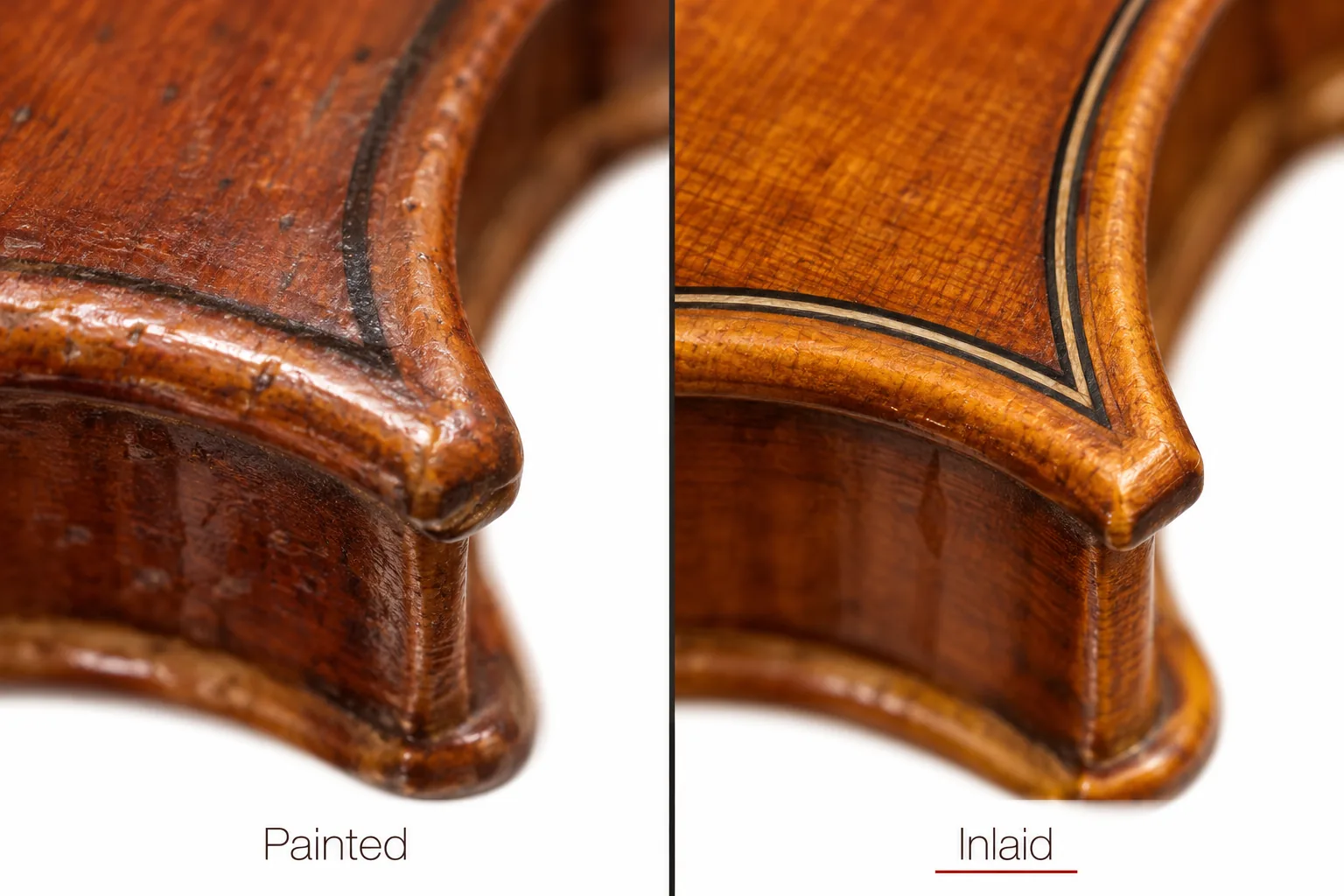
The term gets applied to instruments that share almost nothing except a country of origin and an era. From roughly the mid-1800s through the 1930s, the violin-making regions of Saxony and Bavaria produced instruments on an industrial scale using a division of labor.
One household carved scrolls, another bent ribs, another handled varnish and final assembly. Enormous numbers were made and shipped worldwide, many of them through catalog and mail-order sellers.
Within that output there are three broad tiers, and they matter more than anything else in this discussion.
Tier one: the low-grade trade instrument
Built to hit a price. The wood is whatever was on hand, plate thicknesses are uneven or simply too heavy, the purfling is often painted on rather than inlaid, the scroll is roughly cut, and the varnish is a hard, cooked-looking finish laid over everything. These can be charming, and they can be perfectly serviceable for a beginner. They will not sound like a professional instrument no matter what work is done to them, because the limits are built into the box.
Tier two: the mid-grade workshop violin
Better wood, more careful shaping, real inlaid purfling, cleaner edges and corners, more attention paid to plate thickness. These are worth taking seriously. A good mid-grade Saxon or Bavarian workshop violin in sound condition, with a proper setup, can be a genuinely satisfying instrument. Most of the pleasant surprises we come across are in this tier.
Tier three: the shop-made instrument by a named maker
Some German makers ran small shops and signed their work, building instruments individually rather than as pieces moving down a line.
Names like Ernst Heinrich Roth, Heinrich Th. Heberlein, the Klotz family in Mittenwald, and Neuner & Hornsteiner belong to this tier, and instruments from workshops like these are what people actually mean when they say a German violin can be a serious instrument rather than a curiosity.
These are not really trade violins at all, though sellers who do not know the difference lump them in. At their best they compete comfortably with good French and English workshop instruments.
Our collection of fine German violins covers instruments from across these regions and quality levels, and it is the quickest way to hear how wide the range runs.
| Tier | What to Look For | Realistic Use |
|---|---|---|
| Low-grade trade instrument | Painted-on purfling, heavy or uneven plates, roughly cut scroll, hard cooked-looking varnish | Fine for a beginner, will not sound like a professional instrument regardless of work done to it |
| Mid-grade workshop violin | Real inlaid purfling, cleaner edges and corners, more even plate thickness | Can be genuinely satisfying with a proper setup, most of the pleasant surprises live here |
| Shop-made by a named maker (Roth, Heberlein, Klotz, Neuner & Hornsteiner) | Built individually rather than on a line, signed work | Competes comfortably with good French and English workshop instruments |
When a seller says German trade violin, they may be describing any of the three. Your first job is to work out which.
Why the Label Inside Tells You Nothing
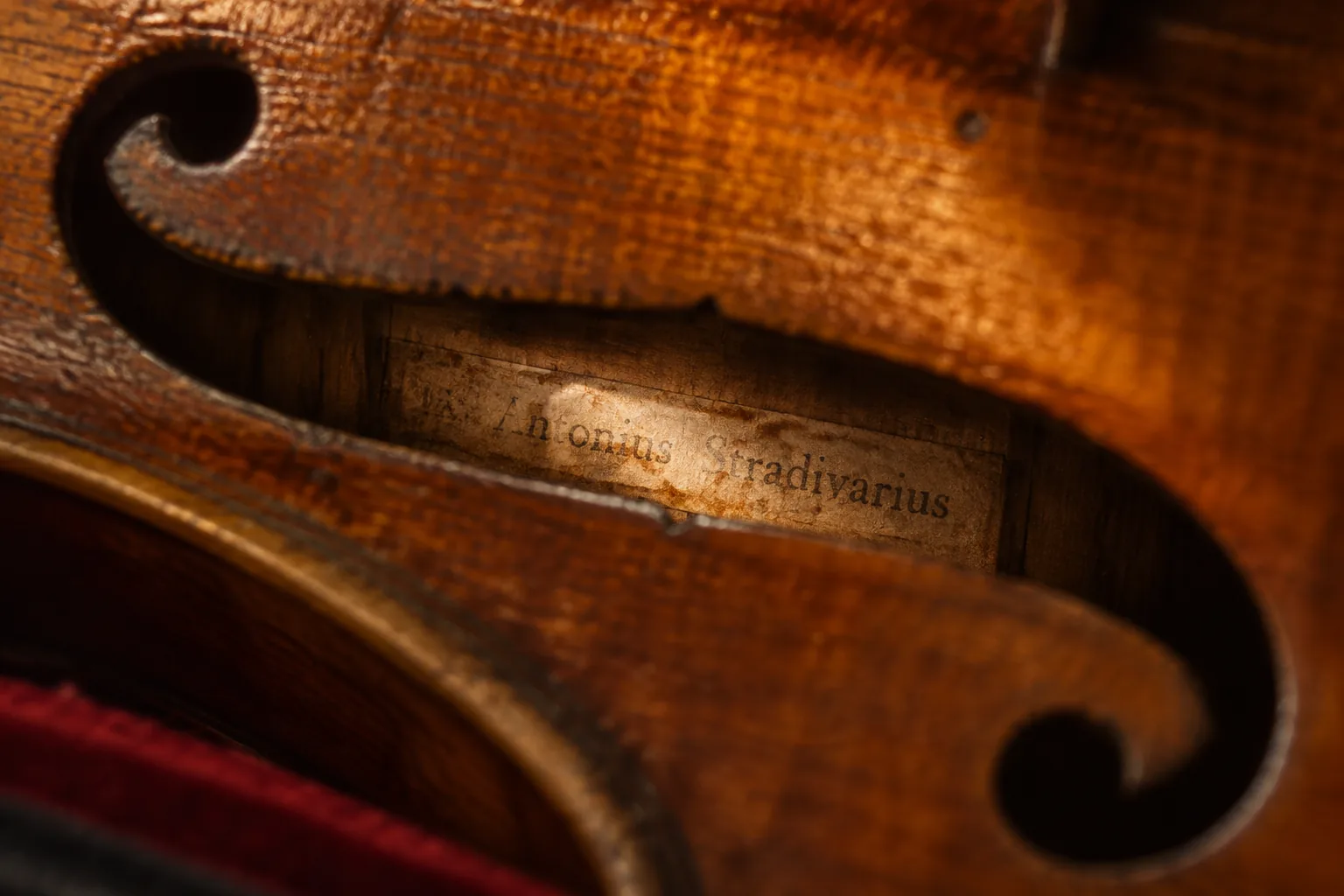
Open almost any of these violins and you will find a label reading Antonius Stradivarius Cremonensis, or Guarnerius, or Amati, or Stainer, usually carrying a date from the 1700s and often with a country-of-origin stamp nearby.
Those labels were model designations: they told the catalog buyer which famous outline the instrument copied, not who made it.
Those are not forgeries in the criminal sense. They were model designations. The label told the catalog buyer which famous outline the instrument copied, roughly the way a furniture catalog says Queen Anne style. Everyone in the trade understood that at the time. A century later the context is gone and the label does nothing but create false hope. Labels are also the easiest thing in the world to reprint, swap, or add, so even a convincing one proves very little on its own.
What actually identifies an instrument is the work: the shape of the outline and corners, how the neck is joined to the body, whether the purfling is inlaid or drawn on, the way the sound holes are cut, the carving of the scroll, the choice and cut of the wood, and above all the character of the varnish. Reading those details takes years of handling instruments side by side.
It is also why a photograph and a label almost never settle an attribution, and why any serious opinion of origin or value comes from having the instrument in hand.
How These Violins Actually Behave in a Hall
Many trade violins sound better under your ear than they do fifteen rows back. That gap is the single most common reason a player buys one and regrets it.
Three qualities separate a professional instrument from a pleasant amateur one. Projection, the ability to carry over an orchestra or across a hall. Dynamic range, the room to play genuinely soft and genuinely loud without the sound collapsing or turning harsh. And color, the ability to change the character of the sound rather than only its volume. Trade violins tend to be limited in all three.
The usual pattern is a tone that is sweet and agreeable at moderate volume but flattens out when you push, or one that thins and turns nasal on the E string, or a G string that never quite fills.
There are exceptions. Now and then a mid-grade workshop violin was finished exactly right, aged well, and simply works. When that happens it is luck rather than pedigree, and you find out by playing the instrument in a real space, not by reading about it.
For comparison, the professional and investment grade violins we carry are the ones we consider suitable for concert performance and recording. Playing a trade violin directly against one of those, in the same room on the same afternoon, is the fastest education available on this subject.
The Repair Math That Never Appears in the Listing
Most of these violins are now well past a hundred years old, and age brings a predictable list: seams that have opened, cracks in the top or ribs, worm damage in the blocks, a sound post crack (the most serious of the common faults), peg holes worn oval, a warped or worn fingerboard, and a neck that has slowly pulled forward so the strings sit too low over the body.
| Common Fault | Severity | Typical Fix |
|---|---|---|
| Open seams | Minor | Reglue, usually inexpensive |
| Peg holes worn oval | Minor | Bushing and re-drilling |
| Warped or worn fingerboard | Minor to moderate | Planing or replacement |
| Worm damage in the blocks | Moderate | Localized repair, cost depends on extent |
| Neck pulled forward, wrong angle | Major | Neck reset, substantial structural work |
| Undersized or poorly fitted bass bar | Major | Full replacement, real surgery |
| Sound post crack | Most serious of the common faults | Sound post patch, opening the instrument and grafting in new wood |
That last one matters more than people expect. Correcting the neck angle is substantial structural work, and it is often the difference between a violin that responds properly and one that always feels slightly dead.
The same goes for the bass bar, the strip of spruce glued inside the top that carries much of the instrument’s power. Older trade violins frequently have short, undersized, or poorly fitted bars, and replacing one is real surgery.
Here is the uncomfortable arithmetic. A single major job can cost more than the finished instrument will ever be worth, and two or three together certainly will. We say that as a shop that does violin repairs and restoration every week: there are instruments we advise clients not to restore, because the money would be better spent on a better violin. Not a fun conversation, but the honest one.
One more point, because it comes up constantly. Original varnish carries a great deal of an antique violin’s value, and refinishing or over-varnishing generally reduces what an instrument is worth. A violin that looks suspiciously fresh and glossy for its age has often been stripped and recoated by someone trying to make it easier to sell. Shiny is not the same as good.
What German Trade Violins Are Actually Worth
Values move with tier, condition, and the market, so treat what follows as orientation rather than a quote. An in-person appraisal is the only responsible way to reach an opinion of value for a specific instrument.
Unrestored low-grade trade violins in doubtful condition change hands very cheaply, sometimes for little more than the cost of the case they arrive in. They are project instruments, and the projects usually cost more than they return.
A mid-grade workshop violin that plays well, with sound structure and an honest repair history, sits in a different bracket entirely: the sort of money an advancing student or a working player buying a backup can justify, and far below what a professional concert instrument commands.
Good shop-made violins by identifiable German makers run higher again, and at that point you are no longer shopping for a trade violin at all.
What you will not find is a genuine trade violin that competes on price with fine instruments while matching them on sound. If a listing implies otherwise, something in the description is wrong.
A note for anyone handling an estate: the same rules apply to violas and cellos from these workshops. Old German cellos in particular are worth restoring more often than violins are, simply because good cellos are scarcer, but the condition assessment has to come first.
Estate collections in Washington DC, Maryland, and Virginia come through our doors regularly, and it is far more useful to look at everything at once than piece by piece.
A Step-by-Step Way to Evaluate One
- Play it in a real space. Not a small practice room. Find a hall, a church, a large rehearsal room, and listen to how the sound travels.
- Bring a second set of ears. Have a colleague play while you stand at the back. What you hear under your ear is not what the audience hears.
- Test the extremes. Play as softly as you can, then as loudly as the instrument allows. Note where it stops responding. That ceiling is your real limit on stage.
- Look at the structure. Check the seams, look for cracks in raking light, look at where the neck meets the body, and see how high the bridge stands. A very low bridge usually signals a neck that needs resetting.
- Ask for the repair history in writing. An honest seller will tell you what has been done. Vagueness is information too.
- Ask about the varnish. Has it been retouched, polished, or refinished? That affects both sound and value.
- Take it on trial. Live with it for a week or two, in rehearsals and lessons, not just in the shop.
- Compare it against everything else at that money. This is the step players skip, and the one that changes minds.
When a German Trade Violin Genuinely Makes Sense
There are real professional uses for these instruments, and we sell them for exactly these reasons.
As a second violin, the one you take to an outdoor wedding in July, a park concert, a school workshop, or a long trip, without risking your main instrument. As a pit or folk instrument, where a strong, direct, uncomplicated sound can serve better than a refined one. As a teaching studio instrument, so a student who forgot their violin still has something playable in the room.
And as a first serious step up for an advanced student who has outgrown a factory student outfit but is not ready for a larger purchase.
| Use Case | Good Fit? | Why |
|---|---|---|
| Second violin for outdoor gigs, weddings, travel | Yes | Protects the primary instrument without much downside |
| Pit or folk playing | Yes | A direct, uncomplicated sound often serves better than a refined one |
| Teaching studio backup | Yes | Keeps a student playing when they’ve forgotten their own instrument |
| Step-up for an advancing student | Yes | Bridges the gap between a factory outfit and a bigger purchase |
| Primary concert or recording instrument | Rarely | Projection, dynamic range, and color are usually the limiting factors |
In all of those roles the value is genuine. As a concert instrument for a professional career, it very seldom is.
What Else Your Budget Buys
Once a player starts comparing instead of shopping for a category, the picture usually changes. Players who purchase French violins from the Mirecourt tradition often do so because those instruments tend to offer consistent construction and a focused, projecting sound, and the difference between a French Mirecourt violin and a Paris violin is worth knowing before committing to either.
Weighing Italian vs. French violins comes down to the same variables as everything else here: work, condition, and sound, not the country on the label. English violins are the well-kept secret of the same price bracket, frequently undervalued relative to how they play.
Contemporary makers deserve a serious look too, since a new instrument by a living maker arrives without a hidden century of repairs behind it. The same holds a step up in size, where a well-chosen vintage cello often outplays its price.
Each of those is judged the same way: by the work, the condition, and the sound, never by the name on the label. A French violin is not automatically better than a German one. The point is that German trade violin describes a manufacturing method, not a quality level, and once you listen across categories you start buying the instrument rather than the story.
Bringing One In for an Honest Opinion
If you already own a German trade violin, or you are weighing one up, the most useful next step is to have someone experienced put hands on it: examine the structure, assess what work it needs, play it, and tell you plainly whether it is worth restoring, worth keeping as a backup, or worth trading toward something better.
An appraisal is a professional, informed opinion of value based on what the instrument actually is, and it is worth having before money goes into repairs.
One practical note on timing. The shop is busiest from October through January and again from May through the end of June, when auditions, school terms, and upgrade decisions cluster. If you are working toward a specific date, come in early rather than late. Good instruments sell, and restoration work takes the time it takes.
Related readingAuthentic 18th-Century Violin by Josef Klotz Jr. | WFVRead the guide →Frequently asked questions
What exactly is a German trade violin?
Are German trade violins worth buying for professionals?
Does the Stradivarius label inside mean anything?
How much is mine worth?
Is it worth restoring one?
What about German violas and cellos?
Come Play a Few Side by Side
If you want an honest answer on what your German trade violin can actually do, and a clear picture of what the same money buys elsewhere, Washington Fine Violins specializes in exactly this kind of decision.
We bring more than 25 years of hands-on experience matching players with instruments that fit how they actually play, and we can help you find out whether the violin in front of you belongs in a professional’s hands, a student’s, or a case in the closet.
Here is what you get with an in-person evaluation at Washington Fine Violins:
- A hands-on read on construction, condition, and repair history, not a guess from a photo or a label
- An honest answer on whether restoration will cost more than the instrument will ever be worth
- A side-by-side comparison against French, English, Italian, and contemporary instruments in your range
- A clear next step, whether that’s restoring what you have, keeping it as a backup, or trading toward something better